
This article is by Martin White.
Every epic needs an opposing force, and in most high and heroic fantasy, that opposing force is evil. Sometimes, it’s literal Evil with a capital E, embodied in an army of twisted champions. Other times, it’s the sort of evil that kicks puppies and kidnaps damsels. Either way, it contains within it the author’s conception of the things that humanity would be better off without.
I don’t typically write about evil people. Many of my characters, both protagonists and antagonists, have traits that could be called evil, but I’ll never have more than one character per story who’s completely, undoubtedly, irredeemably evil. More often, the concept shows up only in first-person perspectives, and it’s called into question whenever the accuracy of those perspectives becomes questionable. In this essay, I aim to show why.
Why I Don’t Portray Real Groups as Evil
I’d like to begin with a statement that will hopefully not be controversial: unlike some writers and rhetoricians, I don’t portray queer people as all being rapists. Although I’m queer, and I don’t consider myself evil, it doesn’t really bug me when other people classify queerness as evil–evil is subjective, and sometimes it’s really cool. However, I do mind when people assume that because I’m queer, because queer people are evil, and because rapists are evil, I must be a rapist. Setting aside the issue of personal offense, the logical leap that I dislike goes like so: If this person has a trait that I oppose, he or she must have all traits that I oppose.
Now, casting our scope wider, we find this leap all over the science fiction, fantasy, and (to a lesser extent) thriller genres. Pick any story not by Robin Hobb in which Christians fight pagans, and either the pagans are evil and knowingly worship Satan, or the Christians are unknowingly worshipping Satan, and the few Christians who aren’t evil will all convert to paganism upon realizing this. Pick any story in which Christians fight atheists, and either the atheists are amoral and selfish, with no redeeming qualities, or the Christians are self-righteous and hypocritical, with no redeeming qualities. Authors who are afraid of gays will make their bad guys gay, authors who are afraid of conservatives will make their bad guys conservative, and there are a handful of authors who may be afraid of blacks (though if they are, they thankfully have the good sense to disguise them as non-humans.) Many of them have clearly read books by authors with opposing prejudices, but they’ve responded by hardening in their own prejudices, rather than by writing without prejudice.
Do I really need to say that I consider this bad? It’s gotten to the point where I won’t even read a fantasy that has a clear analogue to Christianity, because I already know someone’s going to be humiliated as their worldview comes crashing down on them, probably shortly before they die horribly.
Why I Don’t Portray Fictional Groups as Evil
Of course, if you don’t write based in prejudice, this all may seem like so much talk to you. There are no orcs or vampires to protest your fictional treatment of them, so why can’t you portray them as pure evil? I can’t speak for you in this. I can only speak for myself when I say that I don’t want to give the thought “some groups of people are all evil” any credence even in a fictional context.
In our “nonfiction” media, and in our daily lives, we are surrounded by evil. Drenched in it, even. Depending on your news source, you may already be certain that liberals are evil, or else that conservatives are evil (though the term you’d probably use is “crazy.”) Depending on your religion, you may already believe that gays, abortion doctors, or people who have sex before marriage are evil (though the term you’d use is “sinful.”) Maybe you carry a pro-Israel sign and talk about the evils of Palestine, or maybe you carry a pro-Palestine sign and talk about the evils of Israel.
Some authors respond to this by writing about what they consider the “real” evils in the world–the acts of cruelty and hypocrisy that two opposing factions often commit against each other. I’m not quite that ambitious, so I’m more likely to leave evil out of my stories entirely. We’ve got far too much of it already for me to add to the supply.
Some Qualifiers
This doesn’t mean I portray everyone as good. Some characters are selfless and brave, since some real people are selfless and brave. Some are genuinely irredeemable, since some real people seem irredeemable (though generally not in large groups.) But most of the time, I show what characters think of themselves and each other, and I let the readers decide who’s thinking wrongly. If a character is sufficiently repulsive, his self-justifications will ring hollow, and readers will tag him as a “bad guy” just as readily and easily as if I’d set out to write him as one. But if I think of a character as awful who really isn’t that bad, readers may be drawn to my neutral portrayal of him–and conversely, if I write neutrally about a character whom readers might have thought of as bad, it’s possible they’ll grow to like her.
Nor does it mean that my stories don’t have antagonists. Sometimes, they’re even antagonists from one of the above-mentioned stereotyped groups. But while they’re probably in the wrong (or at least less in the right than the protagonists), there’s more to them than “Hi. I’m evil.” They may have noble goals, or use honorable methods, or maybe even turn out in the end to be right after all. They’re complex, just like real people.
How do you approach evil in your stories? Do you similarly remove it? Do you try to tame it? Or do you use it like any other tool?
About the Author:
Martin White is a college student studying to become a budget analyst. In his spare time he writes fantasy, romance, and fantasy romance. His short story “Five Conversations on a Pier After Dark” will appear in an upcoming issue of InD’Tale Magazine.

You say “Evil” like it’s a bad thing. 🙂 Evil certainly makes motivation easier. You must have conflict of some kind, and Draconian-Overlord-Bent-On-World-Domination comes out of the box with Instant Conflict and Instant Hero Motivation. Most readers won’t question why the protagonist needs to rise up against Sauron from LOTR, The Empire from Star Wars, or the Red Queen from Alice in Wonderland. They’re just Evil and need to be opposed.
And without Evil, you can’t write Horror. Or Crime Murder-Mysteries.
However, if your antagonist is 100% pure evil without a reason then that’s a pretty shallow and boring antagonist. Think of any teen-slasher-cabin-by-the-lake-horror stories. If you choose this path, then you need to bring something else to the table, the way LOTR, Star Wars and Alice In Wonderland did.
But as you say, Evil is not necessary. There are three sides to every story: yours, mine and the truth, and the best fiction takes advantage of this. The most interesting villains are ones that have some depth and motivation. The current TV show “Revolution” does a good job with this – it has no clear cut Good or Evil, just opposing philosophies of how the world should work.
What is necessary is conflict, so if you don’t have Evil, then you need to establish some other reason for the protagonist and antagonist to clash. This is hard work, but good writing is hard work. Kudos to you for challenging yourself, I’m sure your writing will be more interesting because of it.
@Morgan Sorrell
Some of my favorite characters in literature are the anti-heroes, the characters who seem “evil” due to their actions but once their motivations or past experiences are revealed you see how layered they really are, like Raistlin Majere or Severus Snape. Of course, many of these characters often experience redemption in the end. Good luck with Mordred. That is an excellent character to explore.
Sometimes the stereotypes are embedded so deeply, it’s difficult not to work them in even if you don’t intend the connections. This is how archetypes develop. I am Christian, but I do know that some people are so obsessed with their viewpoints their actions tend more toward evil than toward good.
I think you bring up some good points. My favorite characters are those with shades of gray. Look at Jaime in Game of Thrones. He starts out as irredeemably evil and changes considerably as the series progresses.
@Lyrie Agreed. I love Jaime and his character development BECAUSE there are shades of gray with him…how he changes is what makes him interesting.
@annedreshfield When I first started the series I hated Jaime so much and now I rather like him. He definitely did some evil things but was also rather misunderstood. I guess I’m Brienne in regards to him. 😉
@Lyrie Definitely! Yeah, I started liking his character and being attracted to his wit and the way he was changing in regards to Brienne…and then I was horrified by myself because I remembered how much I hated him in the first book. Well done, GRRM, well done. *bows down*
@annedreshfield I know what you mean LOL. You get to where you’re like “Hey this guy’s not so bad” and then you remember he threw Bran out a window.
@Lyrie @annedreshfield To me, these are the villains we hate to love. I love a good complex character that I know I’m not supposed to like, but I do anyway. In that scenario, the author has it played it well.
@Beida @Lyrie Absolutely!
I think this depends on your definition of evil. Some of the comments make it sound like evil means having no good qualities at all, and I don’t necessarily think that’s the case.
Interesting premise. I think if a character is portrayed as truly real, there are very, very few truly evil people without any redeemable qualities. I think the novel would be much more believable if one were to follow your advice.
@SeanDavid I agree, SeanDavid. It’s kind of like how no one is perfect. To be 100% evil to the core is pretty unlikely. I like to go with the dirty rotten scoundrel approach.
I like this article because my main character is Mordred, the son of King Arthur. My intention is to give a bit of background about his childhood and his relationship with his various family members.
I didn’t change the ending however. He still plots to reveal Lancelot’s affair with the queen, and he still leads an army against his father. I just hope that I was able to show what his actual motivation was for his actions.
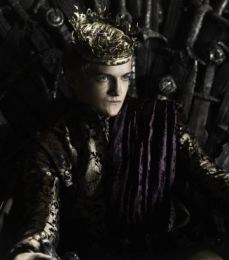
Fantastic post, Martin. I agree with you. Even as a huge Lord of the Rings fan, I can recognize that Sauron is probably 100% evil, and everyone else that falls behind him is lured by greed, lust for power, and so on and so forth. I like some context for my evil. You pictured Joffrey, and while he’s an obnoxious little evil shit, there’s still a reason for him being evil. It’s alluded to that it’s mental illness. Like @Antonio del Drago said, it’s real. That’s pretty darn convincing for me as a reader (and as a writer, if the evil doesn’t have motivation or explanation, then just stop writing).
I really appreciated this article, and the discussion that it has raised. At the same time, though, I would like to mention a stark reality that I have faced:
There are, in fact, people in this world who really, truly are evil.
While rare, I have on a few occasions encountered people who have allowed themselves to be consumed by evil. Perhaps the most striking example is a murderer that I had the misfortune of encountering. He had no visible remorse, and seemed to be content with his crimes. The man is currently sitting on death row.
Yes, I know that everyone (supposedly) has some goodness in them. And I’m sure that this killer had a tragic childhood worthy of sympathy. But by the point that I ran across him, he had consciously chosen the path of a serial murderer. He allowed evil to overtake him, to the point that it became his defining characteristic.
So yes, evil can be real. Not everything is gray. It’s worth remembering this when creating our villains.
Ciara mentioned that she writes without prejudice. I’m going to respectfully say that such a feat is impossible, but what she likely meant is that she tries not to demonize any one group. It’s a worthy goal, and one I must too grapple with. I realized that may portrayal of one group of professionals in my upcoming novel was uniformly bad, and I am making efforts to humanize them.
Species of evil, such as orcs, goblins, and dark elves, have always unnerved me. Accepting that different races of humanoids can be inferior and should be eradicated is not the sort of moral I want in my writing. That said, some people enjoy the fantasy genre for its simplicity, it’s comfort of black and white, evil and good, an escape from the confusion of reality. In my stories I have decided not to portray any one group of people as evil, but I do have groups of monsters that are threatening humanity. This is a step in the right direction. Watch out, though, as I might rebel even against that and depict some humanity in the monsters.
I write about evil, but that’s different from writing characters who think of themselves as evil. Sometimes a person thinks they’re doing what’s best for the world, and all they’re doing is inflicting unnecessary misery and suffering on the world. And that can be portrayed as evil.
I generally avoid the term “evil” for people who’re doing the wrong thing for what they think are the right reasons, but it’s a valid phrasing. (I don’t use it because I worry that it sets up too much of a difference–if we say the Nazis are evil, and we become certain we’re not evil, it’s harder to recognize when we follow in their footsteps.)
Sorry,
I just had to add that I don’t know if people can write without prejudice. Everyone is prejudice about something or someone. I think that will come out in your writing eventually if you are honest. It doesn’t mean it will be publishable. It could be complete garbage and ugly. I think there’s some prejudice peeking out in this article, but at least it’s an attempt to be honest. Not to go on too big a spiel here but: I want to be able to write whatever I want and for everyone to write whatever they want and forget about hurting somebody’s feelings. We (USA) have a right to free speach (for now). We don’t have a right to not be offended. That notion is silly and immature. So go ahead and offend me! I can always just change the channel. 😛
I agree that people in a given group are not all evil, and there may be individuals among them who could be called evil, but would also argue that a lynch mob is evil. Their motivation is to do evil. People generally are not evil, but do evil – even the “good”. I believe everyone is capable of doing evil. It’s in our DNA. That lynch mob might be all good upstanding citizens under normal circumstances, but some terrible pain has changed them – driven them insane (perhaps temporarily). If they can be made to understand what it is they are doing, if they can be made to empathise with their victim for even a second, they can be defused to return to their normal “good” lives. People are not evil, but can do evil.
In writing, I think it’s important that all characters be capable of showing just how complex they are. It depends on what purpose is needed for the story. Story is king. If I need a realy “evil” person, I write one. If I need a “good” character I write that. But always they should be more than that monochromatic.
In a sequel I’m in the midst of rewrites on, the villain (who appeared in the first book) is very complex. He ended up in about half the 2nd book and shows many sides, but always his baser instincts rule him. Sure, he loves, has human desires, and does what he considers to be right, but he’s selfish and power hunger and in a position of power, which give him reign to act as he wishes. I think he’s going to be a part of the book that many readers are going to be excited about. Not because he’s evil, but because he’s complex and interesting and human!
I’m interested if you could site more of these books that you describe in the article. In the case of writing characters who are “evil,” I think it’s not the writer’s job to show how evil a particular group of people are, but to write an entertaining story. I’m personally not interested in writing that has some special agenda behind it.
One reason I didn’t specify names is that there’s usually a degree of plausible deniability–“This book isn’t about pagans, it’s about evil monsters that happen to worship pseudo-pagan deities, and their defeat by heroes who happen to resemble medieval Christians!”–and I didn’t want to start an argument over any specific book. But as one example, the much-maligned Chronicles of Blood and Stone states that evil magic makes you bisexual, and heavily implies that being bisexual makes you evil.
(For some reason, the most frequent case where the parallels are made obvious is when heroic pagans fight misguided Christians–perhaps because the Christians aren’t actually evil, they’ve just been tricked into following an evil god? Examples include everything from The Wayfarer Redemption to Luminous Arc 2.)
I was really confused reading this post until I got about halfway through and read this line:
‘Of course, if you don’t write based in prejudice, this all may seem like so much talk to you.’
Then the light-bub went on LOL. I really don’t think I DO write in prejudice. I don’t write evil people. I write people with real justifications who think they are doing the right thing – because doesn’t everyone believe they are the hero of their own story? Where there are groups of ‘evil’, it’s because people with the same views, histories and actions banded together (drawn together by their similarities) rather than because anything else unites them (such as physical characteristics or pre-existing religious beliefs or sexual orientation). I can think of one group united by physical characteristic but that was because, drawn together by common outlook, they genetically modified themselves to be that way – and even then, they were part of a larger group, some of which split off and took different views, so even then it wasn’t a consolidated group.
I thought it was self-evident that ‘bad guys’ by any name should behave like real people, with real motivations, and with redeeming qualities, and I have to say it vaguely worries me that apparently it’s not.
I don’t know. Is there always a strong basis for trying to characterize an author’s intent with the portrayals in their work? Maybe, for instance, the author just feels that gay rapists fit more readily into a violent medieval society.
Works like Thief, where everyone is a bastard, are outside the scope of this article (although admittedly, I didn’t think of those until after I’d already written this.) The works I’m thinking of are ones in which one side is clearly intended to be good, and embodies the things the author considers virtuous, while the other side is clearly intended to be evil, and embodies the things the author considers villainous.
Great piece. It’s so good to hear a balanced perspective. I refuse to read a heck of a lot of political commentary for just these reasons.
My own stories tend toward the fairy-taleish end of fantasy, which often means a certain archetypal portrayal of evil. Out of similar feelings to yours, however, I try to avoid any reference that suggests a particular group. I see the challenge as matching abstract negative acts or dispositions to some sort of motive that’s believable in context of character and situation. Archetypal wickedness is far more believable if the character is not actually human or has been messing with big dangerous magic; of course, this can also read as an authorial cop-out, so… yeah, it’s a challenge. 🙂
I for one am a little upset about the way the Press treats the poor, misunderstood Orcs.
Good article.