
When I first began writing I would sit in front of the computer for hours, staring at a blank screen. I hoped that inspiration would strike, but usually it didn’t. So I would force myself to type something, praying that it would turn out to be half-decent. Back then writing was a long, tortuous process.
And then I discovered outlining.
When I made a detailed outline in advance, writing became a breeze. The outline served as a road map, reminding me where I was headed. Because I knew that the story was going someplace worthwhile, I had the confidence to proceed at a brisk pace. Writing was no longer painful.
So clearly outlining is a beneficial practice, right? Stephen King disagrees.
Spontaneity and Creativity
King has strong opinions on the subject. In his book On Writing, he argues that outlining – or “developing the plot,” as he calls it – is “the good writer’s last resort and the dullard’s first choice. The story which results from it is apt to feel artificial and labored.”

King’s approach is to simply sit down and write the story, allowing the situation and characters to take him where they will. He is a spontaneous writer:
I don’t take notes; I don’t outline, I don’t do anything like that. I just flail away at the goddamn thing.
I can see the benefits of this approach, as well as the potential dangers of outlining. Characters can redefine themselves in unexpected ways throughout the course of writing. And it’s not unusual for a scene to turn out differently than how you first envisioned it. If you are slavishly following an outline, the outcome may very well feel forced – especially if it conflicts with how the characters develop during the course of the story.
Yet isn’t it possible to use an outline as a flexible guide, allowing the story to evolve as you move forward? Creating an outline does not require you to follow it to the letter.
A Useful Tool
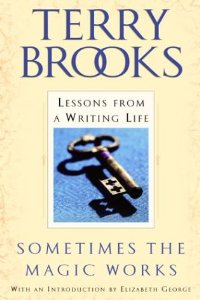
A different perspective is offered by Terry Brooks in his writing memoir, Sometimes the Magic Works. Unlike King, Brooks is a firm believer in outlining. He argues that writing an outline can actually help you to be more creative:
Perhaps the best reason of all for outlining is that it frees you up immeasurably during the writing process to concentrate on matters other than plot.
This has been my experience. When I know where the story is going, I can focus more attention on characterization and dialogue. Other parts of the writing process can flourish because I have thought things through in advance.
There was recently a discussion on outlining in our Fantasy Writing Forums. The general consensus was that some writers work more effectively with outlines, while others prosper without them. It would seem that different personality types gravitate in one direction or the other.
What is your perspective on this issue? Do you outline? Or do you agree with Stephen King?

People like King, or Isaac Asimov or Georges Simenon–there are many writers like this–can just flail away because they have a gift. It is like having perfect pitch or a sense of rhythm. It is like the artist who has a natural sense of composition and color. If you have it, great!
But if you don’t, then flailing is only going to get you drowned. Figure out where your talents lie and cultivate them. Figure out your weaknesses and compensate. Me, I’ve got plenty of weaknesses. A real authority on that front, I am.
I’ve done both.
I wrote a novel (116K words) based on a friend’s un-shot screenplay. Although I radically changed much, the characters and the order of events remained the same. So, the script served as an outline although it was not my outline.
I wrote a similar sized novel completely my own without an outline. I had two characters in mind at the start, a situation, and a general conclusion (they save the world.) It’s a science fiction conspiracy novel and I found that the most important thing was that I had a tone to it of scientific plausibility that I hewed to and that it was the story of the two main characters as much (or more) as it was a general save-the-world plot.
I found the script-outline helpful and I’m proud the result. An outline does not mean you can’t change things as your characters and events demand.
The science fiction novel also turned out really great–it really flows nicely although I made up the events as I went along. It was almost like there was a plot outline out in the aether–things almost magically came together. I’d sometimes go WOW, so THAT’S why such-and-such person did that earlier! I feel that organization occurred in my sub-conscious while sleeping. I’ll say this: I only saw some of those cool connections after I completed the 1st draft and wrote a synopsis, then I was able to go back and punch them up, adding more meat to the skeleton.
I suspect that King is outlining but isn’t aware of it. He’s a frigging genius! There must also be some mutant who can do the Sunday NYT Crossword in their head without writing it in the little boxes.
I’m sorry if anyone is made to feel guilty about any technique I have or will use but I’m not going to jump on King about that comment–each artist has to think that what they are doing it the way to do it, and preach it loudly, else their own confidence might wane. It’s art–we don’t have to take someone’s advice to themselves as what’s right for us. Just smile and say, “That’s nice Stephen.”
I appreciate this discussion because I’m hoping to outline my next novel and see how that goes. I already have a general form and outline in my head so think it might help to lay it out and get thinking about how my main characters think about what’s happening and I want to understand the general thesis. The first novel (this would be the 2nd of a series) hit on “blind ideology,” and I’m not yet sure what over-arching theme is rattling around in my noggin for the 2nd. It’s good to know that overall theme before setting down the first word and if you are not doing that, you are a crappy writer!!! (just kidding!)
Happy writing!
Excellent points, Allen. I also suspect that King may be outlining unconsciously. As you said, he’s a genius.
The danger of out-lining is that it can become a substitute for actual writing. I know a couple of would-be writers who have spent years out-lining and then, as they put it, “polishing” the out-line and time passes without any actual writing taking place.
stevenmlong It’s easy for Stephen King to say that outlining isn’t necessary. After all, his way has worked out great for him.
But alas, most of us aren’t Stephen King.
Having an outline is simply a way of allowing yourself to have a destination. Some find it harder to sit at a computer trying to discover that next pivotal moment in the story after the flow of creative ideas has been stemmed from the last chapter’s increasingly intricate dialogue. How can you get from point A to point B if you have no point B? You make a point B on your outline and fill in the gap between with character
development, back story, etc. If some profound inspiration comes to
mind on the way, great! you can simply follow the route in your mind rather than outline. If you feel that this new-found idea is fading away like a dream you simply go to your outline and add/replace it to the next point.
Obviously, I’m an outliner (http://mythicscribes.com/writing-process/benefits-of-outlining/), but I think it’s up to each individual writer to do what works for them: if the end result is a solid novel, rock on!
I haven’t read King’s book, but my guess is that like a lot of successful people, he’s lost track of the difference between what objectively works, and what works for him and might work for someone else, too.
I am an aspiring writer and from what I can gather, each person should go with what they feel the most comfortable with. It is imprudent in my opinion to say one way is the best way, when there are millions of different personalities going about it in different ways and from different perspectives. Thank you for your blog, as it has been a huge help in finding my own path. [email protected]
raynejohnson Thanks Rayne. I’m glad to hear that the blog has been helpful to you.
Just being a bit of a blonde here, but how do you write an outline? What is the definition of it? Cause I’m about to start writing a book, and I don’t know what it means to outline the damn thing.. I’ve summarized, and from there on I’m pretty much stuck.. How do I write a synopsis as well? Help?
Hi Bell,
The following thread offers several approaches to creating an outline:
http://mythicscribes.com/forums/writing-questions/5581-writing-outline.html
That should help to get you started.
Stephen King’s opinion on outlining is pretty much worthless. The entire point of outlining is to stop your story from meandering too much, and to ensure you get to a satisfactory resolution at the end of it, These are two areas King has *never* been good at. He’s notorious for meandering and bad endings. So for him to tell other writers that his way of writing is the only real way of writing, really shows his arrogance. Having an outline, doesn’t have to be restrictive. Would you build a house without planning it first? No, of course not. It would end up with weak structural points, gapping holes in the floor, and somewhat reminiscent of the leaning tower of Pisa. But with a plan, you can lay your foundations, build your house, then splash a load of colour on the walls to make it your own unique vision. That is the point of an outline; not to tie you in like a straitjacket, but to guide you on getting through the basic structure without your story being left a wandering mess that doesn’t know where it’s going. This doesn’t mean you are creatively stifled; if anything, knowing where your plot is headed, gives you more time and mental space to think about characters, dialogue, voice, and all the other little touches that make your novel yours.Best advice is to do whatever feels right to you as a writer, and ignore any advice coming from Stephen King 😉
For me, the answer is in the sticky middle ground between outlining and pantsing. My gut says: Sit down and write, that shizzle, yo! My brain begs to differ. So I loosely outline major plot elements but don’t fear veering from them if the story needs to change direction. I think all writers occasionally reach a point when something in a scene doesn’t resonate the way it should, where your words are running amock, all loosey goosey on the screen. When that happens I definitely outline that particular scene. I like a solid through line, and arc stability. That is to say I want every scene to have purpose and move the plot forward. Stopping to outline a problematic bit creates a more solid foundation for subsequent chapters.
I think the whole point is moot. Does it matter whether you outline or not? Surely the finished project is what you should be judged on as an author? I outline everything either in my head on on paper and I discover a lot about my characters like this. I also know for a fact that sticking to a outline like glue IS extremely stifling. I hated a character I had previously loved because I stuck too rigidly to my first idea of them – therefore not allowing them to develop naturally. I also discovered that a character I was writing about had had a miscarriage and that no one realised how it had affected her because she came across as a focussed career woman. This was a completely new direction but, having learnt my lesson, I went with only to discover later on that she was evil too! Talk about a twist!
But anyway… Stories talk to people, but before they talk to an audience they talk to their author and it’s proof of a good writer when they listen, learn and understand.
At least that’s what I believe =)
Outline on, if that approach works for you and do not be concerned with being labeled a “dullard” by His Royal Arrogance.
To outline or not outline? That’s not even the question. The one universal constant is that the first draft is toilet paper. If the first draft takes you where you want, its your outline. If it doesnt – then you need an outline.
If you can keep all the details of structure, etc in your head while your write spontaneously, then great – but you will still be revising your first draft – changing characters, scenes, etc for dramatic impact. I think it’s just a prejudice on King’s part certainly.
In “On Writing” King does mention how much faster he was able to write novels while addicted to alcohol and drugs. But he also said how that saddened him, because he couldn’t really remember writing some of his best works.
Hi Samantha,
I’ve run across your “Modern Scribe” blog before. It’s good stuff. I did a lot of research into Egyptian history for my doctoral dissertation, so I enjoy some of your posts on the topic.
Yes, I do recall King mentioning how sad he is that he doesn’t remember writing Cujo. That’s an incredible story.
Yeah always remember that Steven King was an alcoholic and drug addict. When you strip your consciousness down to the sub every night it becomes pretty easy to bang out something you pull from the ether.
Interesting point, Joe. Perhaps that’s why King was so afraid to stop drinking.
I’ve never outlined in my life. This may be a good thing or a bad thing, depending on which side of the fence you’re exiled. As someone who’s never viewed being published as a primary reason for scribbling words on paper, I’ve taken a more stream-of-consciousness approach to what I write. I have no idea what events will greet me when I step out of my house in the morning, and I find an echo of this in my magnum opus (don’t laugh – I’m serious!) As a matter of fact, some of the most interesting characters/events I’ve created have come unbidden and sometimes unwilling.
I suppose the whole debate rises and falls on how an individual’s mind works. Some will find outlining, as the Dragon says, a welcome way to guide the narrative. Others, with perhaps less disciplined minds, will only find the notion a hindrance. I’m not sure there’s a right way or a wrong way, but it certainly makes for an interseting debate.
I generally treat outlines as a loose guide, to be adapted as necessary. I suppose that one of their primary benefits is having a sense as to what comes next. For me, that makes it possible to write each scenes with a specific outcome in mind, which in turns results in more direct, focused writing.
I’m also one of those people who have the general outline of their story stored inside their heads. I do make some notes however, but don’t always keep things that way.
Something I often tend to do is outlining the coming scene, especially if it’s an important one where I don’t want to forget. So it’s probably a mix of outlining and not outlining, I never tend to follow any strict rules with my writing anyway.
Without an outline, I would have a hapless mess…however, in writing my first novel, without an outline, something amazing happened! My story had developed itself, and no longer melded to the original timeline. Time for a new outline that allows for the new events my story now includes 😉
Thanks everyone for sharing your perspectives on this. I always appreciate hearing how other people approach the writing process.
Very interesting read. I have linked to the article on my own blog here; http://jamesloscombe.posterous.com/47428182
I write out extraneous information – references for potential worldbuilding, mostly – but I don’t outline the story. I know the story, a bit, but I accept that it will change when I write it, and I am definitely more like King when it comes to getting out a first draft. I need to sit down and just type it out. Plans change, and they get tossed. Yeah, the first draft is a mess, but I’d like to see a first draft that isn’t shite.
Yeah, there are things that have to be done outside of the ‘sitting at a keyboard and typing’ stage, but I think the most effective writing comes from a first draft acting as an outline, instead of some bullet points masquerading as one.
I used to agree with King, because I love his book, and I felt guilty about outlining. But then I realized that I’m the sort of person who does well with a loose outline. I usually write historical fiction, so if I didn’t do at least some outlining I’d end up with a sorry mess.
I agree with Brooks when it’s something that I really DON’T want to write.
Then I just want to be as efficient as possible and get the damn thing done! Lol.
When it’s my own fantasy work though I don’t outline. I pretty much know the story so I just start typing away.
There have been a few times where I might have written myself into a corner and had to think quick, but I still wouldn’t adopt an outlining procedure.
People offset their memory onto their environment in order to solve problems that have too much complexity to hold in their head. That’s why most people do calculus on paper and not in their head (also they do it for the purposes of communication).
Experts in a specific domain (such as fantasy writing) can hold more domain-specific complexity in their head at once. Thus, I wouldn’t be surprised if newer writers outline more often than more seasoned writers.
I haven’t done a lot of writing yet, but I imagine myself at least starting out heavily relying on outlining.
The part of writing that I’m most interested in is world creation, and I can’t image not mapping that out at least a little ahead of time.