
Goldie's Guide to World Building
The following guide makes the following assumptions:
1) The new fantasy world is Earth sized.
2) The new fantasy world has one Sun.
3) The new fantasy world has one Moon.
4) The new fantasy world has a 23 degree axial tilt.
5) The new fantasy world in all ways functions similar to Earth (goes around the sun, has tides, has 24 hour rotation, and has 365 day years).
If any of these are not true for your fantasy world, then very much of your world can be different and you would have to figure out in which ways to compensate for yourself.
For me, World Building begins with the story in mind, and grows organically as the story calls for it. I do not tend to draw out large world maps, but instead localized area maps until the story starts to expand. Many do not build worlds in this way, they lay much of all of it out at once, and that is fine. This guide is aimed at anyone ready to put thought to paper.
An effort has been made to list the bullet items chronologically, or in order of importance. Such that, you must have mountains before you can have land masses, land masses before rivers and the like.
All of this is just a guide. The Earth itself has many places that would seem to defy this type of world building, and often it's the strange and unearthly that captures the sense of wonder in all of us. That should be encouraged.
Let's Begin:
Plate Tectonics: Worlds are made of plates that lie under the ocean. These plates move and grind against each other causing things like mountains to form and volcanic rings to appear around their edges. Some plates stretch most of the world, and some are ground away to mostly nothing. When plates meet, one tends to push up, and the other gets shoved down. Both cause the land to bunch up, and rock to break the surface. Generally, the rock of one rises up much higher than the rock of the other, and a fault line forms along the edge of the mountains.
Mountains: Mountains are made by great forces. Plates pushing against each other, volcanic activity, meteor strikes in the distant past. When placing mountains, look for areas where continents grate. Mountains tend to form towards the center, and then around them the land is broken. And then around that, is smoother flatter land that spreads out towards the sea.
Rivers: Rivers tend to form from mountain runoff, and are cut into the land by water endlessly looking for lower ground until it hits the sea. Rivers start small, and are joined my many streams and creeks until a main thoroughfare grows into a proper river. Rivers almost never break off into having more than one path to the sea.
1 Correct:
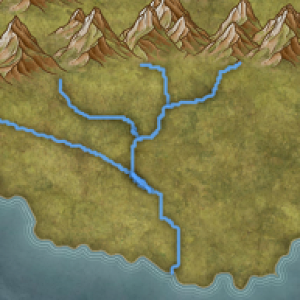 2 Incorrect
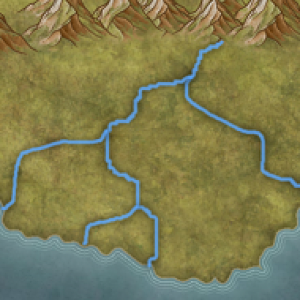
3 Flat Lands
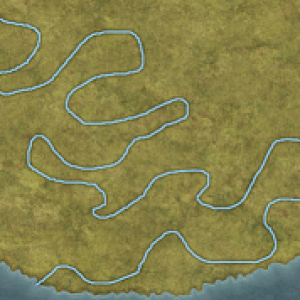
When Land is flat, rivers tend to meander and form long snaking paths.
4 River Delta
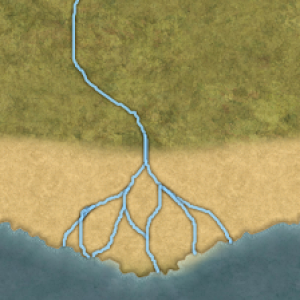
Occasionally, Rivers will end in a River Delta. This is not very common.
Arid lands: As wind blows over the planet, it carries water over the land. This water tends to fall over land on one side of a mountain range, and be more arid on the other. It is not unusual for one side of a range to be desert, and the other side to be forested.
Forests: Forests tend to appear where rivers and water is strong, and where rainfall is plentiful.
Ocean currents: Ocean currents tend to flow in giant circles following the planets rotation. They would flow clockwise in the north, and counterclockwise in the south. The path of these currents would be affected by land masses. It may be overkill, but it might be useful to decide the path of ocean current on a new fantasy world.
Volcanoes: Volcanoes form over hot spots in the earth, or where plate activity is pulling the land apart, exposing the magma beneath the plate. Where there is one volcano, there are usually several, as plates move over hot spots for thousands of years, creating multiple live or dormant volcanoes in a line. Volcanoes can also appear along the edge of continental plates, sometimes forming a ring.
Hills: Hills can generally go anywhere, but it’s a safe bet there would be a layer of hills leading up to any range of mountains.
Swamps: Swamps appear where the land is flat and the water cannot escape to lower ground, or in areas that are below sea level. Swamps can be long snake like rivers or large marshy pools. The water is generally still, and is surrounded by wetland and thick mud, as well as thick growths of vegetation.
Biomes: Assuming the new fantasy world is like our own, biomes and climate will fall along a predictable pattern of colder weather at the poles and warmer weather at the equator. Given the planets rotation, there will be wind streams, and ocean currents that move air and water around the world, mixing both cold and warm together. Clouds will form over bodies of water and drop rain on the land as they pass over. Arid regions will appear where the air is dry and rain is scarce. Following the example of our own world, there would be ice and snow along the poles, colder regions as we move towards the equator, with forests of coniferous trees being common, and then warmer greener regions with more and more deciduous trees. Arid regions appear mostly in the jet streams slightly above and below the equator, and deep lush jungles where the planet is warmer.
Under the water: Tectonic plates underlie the oceans of the world as well, with fault lines and volcanoes deep beneath the surface. If there is need to have adventures underwater, it should be noted that this land also will have mountains and flat lands, and a lot of mud. Reefs would appear in shallower waters along the ocean currents, and the deepest parts of the ocean would be where plates meet and deep gorges are cut through the sea floor.
Peoples: Worlds evolve and people migrate. In the earliest stages, people will be tribal and not venture too far from their home lands, but as the world evolves and travel becomes easier, populations will begin to integrate and lands will become greater mixes of peoples of many complexions. But, in general, the world will have lands that tend to be stewarded by people of similar complexions. Here on Earth, we have many distinctions of peoples. White Men in the north, Brown men in the south, Olive men in the middle east, Yellow men in the far east, Red men in the west. There is no limit to the number of complexions that can appear, but it is likely a fantasy world will have such divisions as well, more so the less integrated the world is. These peoples will have obvious traits that identify them as belonging to a region, and cultural markers as well. Some areas of the world may make for natural mixing pots, but large swaths of land, or natural barriers may serve to prevent it. These differences will likely cause some level of conflict and trade, again depending on the ability to travel, and the level of integration.
Languages: As in our own world, different peoples of different cultures will likely have different languages. As one culture becomes dominant over others, their language may spread and become more of a standard language for a large region, but still their language will be very different from those far distant from them. Additionally, languages grow and change over time, eventually having early and ancient forms that no longer match the current contemporary use of it. Thus English will have an Old English as time moves on. To add depth and richness to a world, languages should be considered as part of the makeup of the cultures that sprout, and that they evolve over time to almost entirely new languages from the same root.
Naming Conventions: Some thought should be given to the names used for places and peoples in a new fantasy world. Just as it would be very unlikely for there to be a George Washington in 1200's China, it would be unlikely for the names common in one culture to be common in another. As you develop a new fantasy world, the words used, and names that are prominent, should represent the culture they are from, and will go a long way to assisting in creating a believable dynamic world.
Currency: Like all things with people, the things of people evolve over time. Early, more tribal, cultures may not make use of currency at all. Such cultures may barter with themselves or with other cultures to get things they desire, but may not find much use for the coins of more sophisticated peoples. Over time, currency will replace a bartering system; however, not all currencies are the same. Coins come in different sizes and different weights. People of one culture are going to notice if their gold coins are bigger than another's and are going to want some way to equalize their buying power. There are many ways this may come about, such as weighing, or some large powers standardizing currency, but no system will cleanly match with another.
Politics: Not surprising, politics is a part of any human community. While communities, and even large kingdoms may seem cohesive, underneath there is always the grumblings of dissent. Sometimes dissent turns murderous, or revolutionary, and sometimes is sparks warfare between strong factions, but politics and governing systems are generally an attempt to resolve disputes without leading to political unrest and bloodshed.
Politics also extends beyond the borders of organized community. All peoples will have opinions about their neighbors, and their neighbor's neighbors. Sometimes they will view them favorably, sometimes not. Sometimes they will discover trust is misplaced, or that old enmities can change. Politics is always in flux.
And in the great scheme of human societies, there will always be grating at the edges.
In organizing, human politics also evolves from simple, tribal elder or strong man rule, to more sophisticated systems, with Kings and Emperors. Each society will be different, and it is very likely that some areas of a world may have an evolved system while other areas of the world do not. The level of sophistication of government should grow to match the many other factors, such as depth of history, evolution of philosophy, age of the empire, level of technology. It should be considered that as one empire grows, other peoples are taking notes and competing, and as one empire falls, another will pick up the pieces.
Evolution, growth, and flux should play part of the back drop in the political definitions of a Fantasy World.
Religion: Religions also tend to evolve over time. In its earliest stages, religion among tribal people will likely be in the form of an animist system, with belief in ancestors, and great spirits that watch over aspects of the world. In time, this system will likely evolve into a Pantheonic belief set, with belief in many Gods, often with those Gods holding spheres of influence over specific aspects of human life. Monotheistic religions tend to come later, in the evolutionary process, with belief in one God coming from the scrutiny of earlier evolutions, or by revelation.
Warfare: Warfare can break out between peoples for many many reasons. At the heart of them is usually some disagreement about resources or influence. When considering war, there are many things that may have an impact on who might be the aggressors, the defenders, who might be most likely to succeed, and who else might be affected that would come to the aid or destruction of another. And there are many things that might give one participant an advantage over another. A nation with guns might prove very effective against one with lances and spears, but if they are outnumbered 1,000 to 1, even the firearms may not win them the day.
One factor that may play a great role in where warfare springs up, and how it is fought, is the terrain and features of the map. The battle of Thermopylae, for instance, was bravely fought for many days primarily because the Greeks held a narrow pass the Persians could not easily go around. When looking at the world map, and considering where nations are placed, geography should play a role in where their border might naturally fall, and where they may find themselves the most vulnerable, and where they may find their easiest path to aggressing against their neighbors. A nation with mountains on all sides may not fear a land invasion, but they may be vulnerable by sea. And a nation smashed between two giant foes with no natural barriers may not last too long without gaining some other great advantages, such as technology, or an ethos of war greater than is typical of others.
Warfare will always be going on in any world. Somewhere, maybe in the great kingdoms, or maybe in the far away swamps of a new amazon, there will be war.
Travel: As early cultures expand, travel, and the means of travel, grow and evolve as well. In the early stages of a new world, travel will keep various cultures from mingling much, and trade between cultures will be slow or non-existent. Early cultures will travel by foot in worlds with no roads, but over time, roads will form, and foot travel will evolve to the use of livestock and horses and carts and wagons. Sea travel will slowly improve as well, from quaint short range fishing boats to sailed craft to explore the world. As sea and land travel improve, cultures intermingle and peoples of various complexions will be seen in areas far from their native cultures. All other things will spread as well, including language, currency, stories and myths, and yes, warfare as well.
Stars: In a Fantasy World far from Earth, the star field the inhabitants see above their planet would be very different from what we see in our sky. So long as the star field does not cause things that would affect the normal operations of the planet, then there could be anything visible in the sky from giant ort clouds, to black holes, to giant distant planets. But it is likely the people of the new world would see patterns in the sky and make their own constellations, and find their own stars to navigate by.
Visual Interest: Fantasy maps often have places that have interesting topology and/or great features that may not seem supportable by regular land formation. But such places add visual interest to maps and many enthusiasts love them. They should be used with care, but not totally avoided. Use with good reason.
Lore: Lore is the one aspect that is completely up to the creator of the new fantasy world, but it's all the cool stuff that makes our world alive. Lore does not have to be fleshed out for every spot on a new planet, and there is always room to build lore organically as the needs arise, whether it is for a game world or a story one, but the more in depth this becomes the more others will find a great fascination in exploring it. Lore can be anything from mythologies to history. It can be about events that happened in the past, or about tales people tell. Worlds are built on stories, and stories unify a people’s beliefs. What the elves tell to their children may be completely different from what the humans tell theirs, but still their stories will persist. It is lore that makes it lived in. And it is the part that really lives with us long after the story is over.
My advice for lore is to let the shapes of the land inform you as to where people and cultures may live, and who their neighbors are, and how they get along. And what kind of history they may have. How does this shape the stories they may tell, and how do the stories shape them. And how does this affect what they think of those around them. Cause nothing lives in a vacuum, all peoples have a symbiotic relationship with everyone else. Their stories would reflect this.
Other Dimensional Gates: In a fantasy world, there may be gates to other worlds. Since nothing like this appears in our own world, there is no model on how these may take shape. However, if a gate is present, and brings in things from across the way, the more this becomes known, the more attention it gets, the more likely people will gather to do something with it. It may even become the cause of warfare, and greed.
Have questions or comments? PM Box
Read my stories: The Eye of Ebon <--for sale on Amazon!
The following guide makes the following assumptions:
1) The new fantasy world is Earth sized.
2) The new fantasy world has one Sun.
3) The new fantasy world has one Moon.
4) The new fantasy world has a 23 degree axial tilt.
5) The new fantasy world in all ways functions similar to Earth (goes around the sun, has tides, has 24 hour rotation, and has 365 day years).
If any of these are not true for your fantasy world, then very much of your world can be different and you would have to figure out in which ways to compensate for yourself.
For me, World Building begins with the story in mind, and grows organically as the story calls for it. I do not tend to draw out large world maps, but instead localized area maps until the story starts to expand. Many do not build worlds in this way, they lay much of all of it out at once, and that is fine. This guide is aimed at anyone ready to put thought to paper.
An effort has been made to list the bullet items chronologically, or in order of importance. Such that, you must have mountains before you can have land masses, land masses before rivers and the like.
All of this is just a guide. The Earth itself has many places that would seem to defy this type of world building, and often it's the strange and unearthly that captures the sense of wonder in all of us. That should be encouraged.
Let's Begin:
Plate Tectonics: Worlds are made of plates that lie under the ocean. These plates move and grind against each other causing things like mountains to form and volcanic rings to appear around their edges. Some plates stretch most of the world, and some are ground away to mostly nothing. When plates meet, one tends to push up, and the other gets shoved down. Both cause the land to bunch up, and rock to break the surface. Generally, the rock of one rises up much higher than the rock of the other, and a fault line forms along the edge of the mountains.
Mountains: Mountains are made by great forces. Plates pushing against each other, volcanic activity, meteor strikes in the distant past. When placing mountains, look for areas where continents grate. Mountains tend to form towards the center, and then around them the land is broken. And then around that, is smoother flatter land that spreads out towards the sea.
Rivers: Rivers tend to form from mountain runoff, and are cut into the land by water endlessly looking for lower ground until it hits the sea. Rivers start small, and are joined my many streams and creeks until a main thoroughfare grows into a proper river. Rivers almost never break off into having more than one path to the sea.
1 Correct:
3 Flat Lands
When Land is flat, rivers tend to meander and form long snaking paths.
4 River Delta
Occasionally, Rivers will end in a River Delta. This is not very common.
Arid lands: As wind blows over the planet, it carries water over the land. This water tends to fall over land on one side of a mountain range, and be more arid on the other. It is not unusual for one side of a range to be desert, and the other side to be forested.
Forests: Forests tend to appear where rivers and water is strong, and where rainfall is plentiful.
Ocean currents: Ocean currents tend to flow in giant circles following the planets rotation. They would flow clockwise in the north, and counterclockwise in the south. The path of these currents would be affected by land masses. It may be overkill, but it might be useful to decide the path of ocean current on a new fantasy world.
Volcanoes: Volcanoes form over hot spots in the earth, or where plate activity is pulling the land apart, exposing the magma beneath the plate. Where there is one volcano, there are usually several, as plates move over hot spots for thousands of years, creating multiple live or dormant volcanoes in a line. Volcanoes can also appear along the edge of continental plates, sometimes forming a ring.
Hills: Hills can generally go anywhere, but it’s a safe bet there would be a layer of hills leading up to any range of mountains.
Swamps: Swamps appear where the land is flat and the water cannot escape to lower ground, or in areas that are below sea level. Swamps can be long snake like rivers or large marshy pools. The water is generally still, and is surrounded by wetland and thick mud, as well as thick growths of vegetation.
Biomes: Assuming the new fantasy world is like our own, biomes and climate will fall along a predictable pattern of colder weather at the poles and warmer weather at the equator. Given the planets rotation, there will be wind streams, and ocean currents that move air and water around the world, mixing both cold and warm together. Clouds will form over bodies of water and drop rain on the land as they pass over. Arid regions will appear where the air is dry and rain is scarce. Following the example of our own world, there would be ice and snow along the poles, colder regions as we move towards the equator, with forests of coniferous trees being common, and then warmer greener regions with more and more deciduous trees. Arid regions appear mostly in the jet streams slightly above and below the equator, and deep lush jungles where the planet is warmer.
Under the water: Tectonic plates underlie the oceans of the world as well, with fault lines and volcanoes deep beneath the surface. If there is need to have adventures underwater, it should be noted that this land also will have mountains and flat lands, and a lot of mud. Reefs would appear in shallower waters along the ocean currents, and the deepest parts of the ocean would be where plates meet and deep gorges are cut through the sea floor.
Peoples: Worlds evolve and people migrate. In the earliest stages, people will be tribal and not venture too far from their home lands, but as the world evolves and travel becomes easier, populations will begin to integrate and lands will become greater mixes of peoples of many complexions. But, in general, the world will have lands that tend to be stewarded by people of similar complexions. Here on Earth, we have many distinctions of peoples. White Men in the north, Brown men in the south, Olive men in the middle east, Yellow men in the far east, Red men in the west. There is no limit to the number of complexions that can appear, but it is likely a fantasy world will have such divisions as well, more so the less integrated the world is. These peoples will have obvious traits that identify them as belonging to a region, and cultural markers as well. Some areas of the world may make for natural mixing pots, but large swaths of land, or natural barriers may serve to prevent it. These differences will likely cause some level of conflict and trade, again depending on the ability to travel, and the level of integration.
Languages: As in our own world, different peoples of different cultures will likely have different languages. As one culture becomes dominant over others, their language may spread and become more of a standard language for a large region, but still their language will be very different from those far distant from them. Additionally, languages grow and change over time, eventually having early and ancient forms that no longer match the current contemporary use of it. Thus English will have an Old English as time moves on. To add depth and richness to a world, languages should be considered as part of the makeup of the cultures that sprout, and that they evolve over time to almost entirely new languages from the same root.
Naming Conventions: Some thought should be given to the names used for places and peoples in a new fantasy world. Just as it would be very unlikely for there to be a George Washington in 1200's China, it would be unlikely for the names common in one culture to be common in another. As you develop a new fantasy world, the words used, and names that are prominent, should represent the culture they are from, and will go a long way to assisting in creating a believable dynamic world.
Currency: Like all things with people, the things of people evolve over time. Early, more tribal, cultures may not make use of currency at all. Such cultures may barter with themselves or with other cultures to get things they desire, but may not find much use for the coins of more sophisticated peoples. Over time, currency will replace a bartering system; however, not all currencies are the same. Coins come in different sizes and different weights. People of one culture are going to notice if their gold coins are bigger than another's and are going to want some way to equalize their buying power. There are many ways this may come about, such as weighing, or some large powers standardizing currency, but no system will cleanly match with another.
Politics: Not surprising, politics is a part of any human community. While communities, and even large kingdoms may seem cohesive, underneath there is always the grumblings of dissent. Sometimes dissent turns murderous, or revolutionary, and sometimes is sparks warfare between strong factions, but politics and governing systems are generally an attempt to resolve disputes without leading to political unrest and bloodshed.
Politics also extends beyond the borders of organized community. All peoples will have opinions about their neighbors, and their neighbor's neighbors. Sometimes they will view them favorably, sometimes not. Sometimes they will discover trust is misplaced, or that old enmities can change. Politics is always in flux.
And in the great scheme of human societies, there will always be grating at the edges.
In organizing, human politics also evolves from simple, tribal elder or strong man rule, to more sophisticated systems, with Kings and Emperors. Each society will be different, and it is very likely that some areas of a world may have an evolved system while other areas of the world do not. The level of sophistication of government should grow to match the many other factors, such as depth of history, evolution of philosophy, age of the empire, level of technology. It should be considered that as one empire grows, other peoples are taking notes and competing, and as one empire falls, another will pick up the pieces.
Evolution, growth, and flux should play part of the back drop in the political definitions of a Fantasy World.
Religion: Religions also tend to evolve over time. In its earliest stages, religion among tribal people will likely be in the form of an animist system, with belief in ancestors, and great spirits that watch over aspects of the world. In time, this system will likely evolve into a Pantheonic belief set, with belief in many Gods, often with those Gods holding spheres of influence over specific aspects of human life. Monotheistic religions tend to come later, in the evolutionary process, with belief in one God coming from the scrutiny of earlier evolutions, or by revelation.
Warfare: Warfare can break out between peoples for many many reasons. At the heart of them is usually some disagreement about resources or influence. When considering war, there are many things that may have an impact on who might be the aggressors, the defenders, who might be most likely to succeed, and who else might be affected that would come to the aid or destruction of another. And there are many things that might give one participant an advantage over another. A nation with guns might prove very effective against one with lances and spears, but if they are outnumbered 1,000 to 1, even the firearms may not win them the day.
One factor that may play a great role in where warfare springs up, and how it is fought, is the terrain and features of the map. The battle of Thermopylae, for instance, was bravely fought for many days primarily because the Greeks held a narrow pass the Persians could not easily go around. When looking at the world map, and considering where nations are placed, geography should play a role in where their border might naturally fall, and where they may find themselves the most vulnerable, and where they may find their easiest path to aggressing against their neighbors. A nation with mountains on all sides may not fear a land invasion, but they may be vulnerable by sea. And a nation smashed between two giant foes with no natural barriers may not last too long without gaining some other great advantages, such as technology, or an ethos of war greater than is typical of others.
Warfare will always be going on in any world. Somewhere, maybe in the great kingdoms, or maybe in the far away swamps of a new amazon, there will be war.
Travel: As early cultures expand, travel, and the means of travel, grow and evolve as well. In the early stages of a new world, travel will keep various cultures from mingling much, and trade between cultures will be slow or non-existent. Early cultures will travel by foot in worlds with no roads, but over time, roads will form, and foot travel will evolve to the use of livestock and horses and carts and wagons. Sea travel will slowly improve as well, from quaint short range fishing boats to sailed craft to explore the world. As sea and land travel improve, cultures intermingle and peoples of various complexions will be seen in areas far from their native cultures. All other things will spread as well, including language, currency, stories and myths, and yes, warfare as well.
Stars: In a Fantasy World far from Earth, the star field the inhabitants see above their planet would be very different from what we see in our sky. So long as the star field does not cause things that would affect the normal operations of the planet, then there could be anything visible in the sky from giant ort clouds, to black holes, to giant distant planets. But it is likely the people of the new world would see patterns in the sky and make their own constellations, and find their own stars to navigate by.
Visual Interest: Fantasy maps often have places that have interesting topology and/or great features that may not seem supportable by regular land formation. But such places add visual interest to maps and many enthusiasts love them. They should be used with care, but not totally avoided. Use with good reason.
Lore: Lore is the one aspect that is completely up to the creator of the new fantasy world, but it's all the cool stuff that makes our world alive. Lore does not have to be fleshed out for every spot on a new planet, and there is always room to build lore organically as the needs arise, whether it is for a game world or a story one, but the more in depth this becomes the more others will find a great fascination in exploring it. Lore can be anything from mythologies to history. It can be about events that happened in the past, or about tales people tell. Worlds are built on stories, and stories unify a people’s beliefs. What the elves tell to their children may be completely different from what the humans tell theirs, but still their stories will persist. It is lore that makes it lived in. And it is the part that really lives with us long after the story is over.
My advice for lore is to let the shapes of the land inform you as to where people and cultures may live, and who their neighbors are, and how they get along. And what kind of history they may have. How does this shape the stories they may tell, and how do the stories shape them. And how does this affect what they think of those around them. Cause nothing lives in a vacuum, all peoples have a symbiotic relationship with everyone else. Their stories would reflect this.
Other Dimensional Gates: In a fantasy world, there may be gates to other worlds. Since nothing like this appears in our own world, there is no model on how these may take shape. However, if a gate is present, and brings in things from across the way, the more this becomes known, the more attention it gets, the more likely people will gather to do something with it. It may even become the cause of warfare, and greed.
Have questions or comments? PM Box
Read my stories: The Eye of Ebon <--for sale on Amazon!
