
This article is by John Garlick.
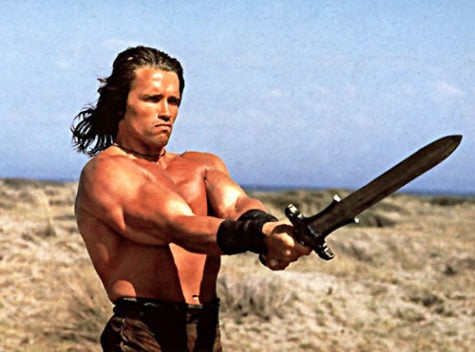
Film is a powerful medium for communicating, even on levels which we aren’t aware of. In watching a film, the viewer is able to take part in their own desires and conflicts, literally “projected” onto the screen in front of them. As a viewer’s perception works on the film, so too do elements of the film work on the viewer, playing off of their psychological histories, and even addressing unresolved issues from childhood. By examining elements of a film through a psychoanalytic lens, we’re able to gain a better understanding of the film itself.
To demonstrate how a psychoanalytic approach to film is possible, let’s examine Conan the Barbarian, a fantasy adventure film from 1982. The film follows Conan on his quest to avenge his slain family and reclaim his father’s sword.
The beginning of Conan the Barbarian is drenched in all sorts of psychoanalytic goodies. For instance, the film begins by focusing on a forge, where iron is poured into a mold for a sword. Several moments are taken to focus on the various stages this object passes through, until we are shown the finished product, a detailed and polished broadsword, held high above the head of Conan’s father. As weapons are generally associated as masculine symbols, the sword almost immediately takes on a phallic nature, a stand in for manly stature, sexuality, and power. This point is further exemplified by the first commentary the audience is privy to, in which Conan’s father explains to his son the “riddle of steel,” a myth detailing how man received knowledge of metal from the gods. Here Conan’s father tells him that nobody is ever to be trusted. However, he can place his trust firmly in steel, i.e. his weapon. Albeit the earliest scene in the movie, this brief moment sets the stage for a host of other things to come.
Conan’s lack of trust and unwillingness to become intimate stems directly from this speech, as does the patriarchal overtone the film takes towards women. Last but not least, the phallic nature of weaponry is delineated, and other imagery of a similar nature will take its cue from this moment.
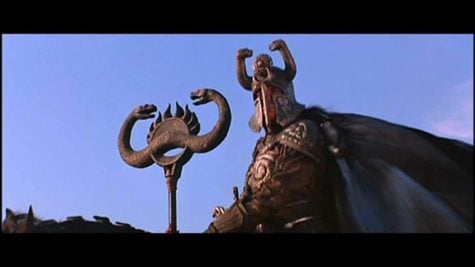
After this speech, the camera immediately shifts to a standard being carried over a hill on horseback. The standard, bearing two snakes facing each other over a black sun, easily becomes an image of significance. Snakes in and of themselves can stand in for male sexuality; however, the unusual image of two facing each other seems to indicate a dual phallus, signifying that the person for which it stands is a character of both great stature and sexual power. As the scene unfolds, Conan’s village is destroyed, leaving bodies strewn throughout the streets. Conan watches his father get torn to pieces by two attack dogs, leaving him clutching the hand of his mother as they watch the destruction unfold.
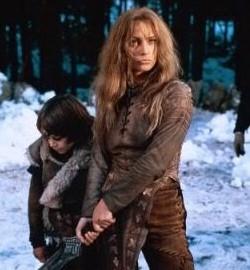
As the chaos dies down, a figure wearing a helmet bearing two snakes steps down from his horse, takes the sword of Conan’s fallen father, and stares down Conan’s mother. At first, the barbarian woman is skeptical and defensive, but lowers her weapon at a mere glance from the almost hypnotic eyes of the imposing figure. To reward her trust, he severs her head, which the camera follows on its path down past the face of the small and innocent looking Conan, who neither speaks nor cries out at all. Through his lack of emotional reaction, we see the first instance of Conan’s response to feelings of attachment and pain: repression.
Repression refers to feelings, memories and thoughts that have been pushed aside from conscious thought. Commonly, these repressed memories come from unresolved family conflicts; thus, they are observed through our interactions with other people. One example of repression revolves around the oedipal conflict, in which a child harbors incestuous feelings for the parent of the opposite gender. Entire films can be analyzed for an “Oedipal narrative,” which focuses on determining how the main male character directs his sexual desire away from his mother or mother figure.
After the death of his mother, Conan is sold into slavery with the other surviving children of his village. Here, he walks in circles pushing a millstone for some twenty odd years. During this montage, we see the number of other children pushing the millstone dwindling, until it reaches the climatic final shot, revealing a well-muscled Arnold Schwarzenegger pushing the stone by himself.
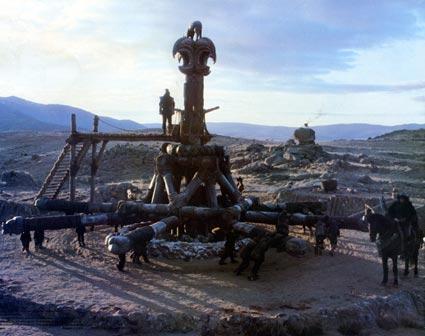
At this point in the film, Conan still hasn’t spoken. His silence would seem to indicate that he is uncertain with human contact, and feels safest to avoid it altogether. His negative experiences with outsiders and the loss of his entire village would seem to support the latter. This repression seems to be viewed almost favorably, as it provides the drive with which Conan becomes a man of great strength. It is also reminiscent of the patriarchal ideal of a man not showing his feelings of love, fear, or loss.
It is nearly twenty five minutes into the film before Conan finally speaks. When asked what is best in life, he responds: “To crush your enemies, to see them driven before you, and to hear the lamentation of their women.” Clearly, this demonstrates that death has become the principal organizer for Conan’s psychological experience, which appears to be viewed as a good thing.
Conan’s response also signifies that joy can be had from witnessing the suffering of others (“the lamentation of the women”), which seems to indicate that pleasure in this film is, at least in part, viewed as voyeuristic. It also seems to create a separation between his mother and the depiction of “other women” throughout the film. Although faced with the death of her husband and her own impending doom, his mother did not cry out or outwardly grieve. Thus, it would appear that while he enjoys hearing other women wail in despair, his mother, and by extension anyone like her, is placed on a higher plane, contributing to the growing Oedipal narrative of the film.
Soon after his release from bondage, Conan meets a young archer by the name of Subotai, and the two become traveling companions. Through a montage of scenes depicting them running through the wilderness, traversing dirty city streets, and drinking in various taverns, it would seem as if a lasting relationship has been established within the film.
It is not long before they both meet a woman by the name of Valeria, who soon becomes Conan’s object of desire. Shortly after their initial meeting, they are shown making love in a scene that lasts several minutes. Despite the voyeuristic nature of the act, it is observable that Conan is openly intimate with this woman, although his lack of speech remains characteristic. Despite this, they are shown laughing together, feeding each other, and cradling each other before resuming the act of lovemaking. Valeria becomes the stand in for Conan’s mother, his fulfillment of the oedipal conflict that had been cut short by his mother’s death. Both women are blonde, beautiful, and acrobatic. More importantly, they are both warriors, which sets them apart from every other woman in the film.
Unfortunately, the couple is not long lasting, as intimacy issues abound. Still seeking revenge for the death of his family and unable to share his burden with his friends, Conan leaves his traveling companion and lover behind to seek out Thulsa Doom, the murderer of his parents. Conan’s pursuit of Doom, who has now become a cult leader, causes him to abandon his sword in an attempt to appear as one of his followers. This is followed shortly thereafter by his capture and subsequent torture. By leaving his sword, the symbol of his masculinity behind, he presents himself weakened before Doom, the near demigod with the double phallus.
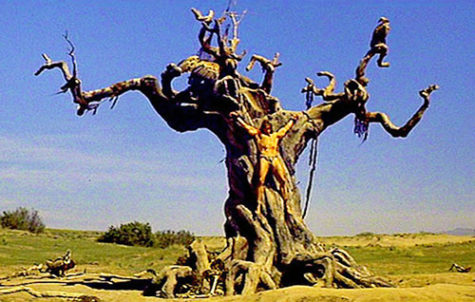
Here, Conan suffers a dual humiliation. Doom informs Conan that steel is worthless compared to the power of the flesh that wields it. To demonstrate his power and sexual dominance, Doom gently calls to a scantily clad cult member, worshipping on the ledge above him. Obeying the supremely masculine Doom, she attempts to reach him, falling to her death. Stripped, beaten and bloodied, Doom demands Conan’s crucifixion on a rotten tree. This is his moment of symbolic castration, which presents him hanging on the tree, being pecked at by vultures.
The image of the crucifixion (reminiscent of Jesus) and of the vultures (much like Prometheus) is significant, as they almost create a sign system that is intentionally violated. According to their respective mythologies, Jesus and Prometheus both sacrificed themselves for the betterment of humanity. Conan, however, finds himself in the situation as the result of his own desire for revenge. Faced with his own death, he laughs wildly before falling unconscious, to be later rescued by Subotai and Valeria.
Although Valeria was the fulfillment of Conan’s Oedipal desire, she is not the extent of the Oedipal narrative. As Doom was responsible for his mother’s death, Conan takes him on as his symbolic father, competing with him for both the memory of his mother and sexual dominance. Throughout the film, Doom is symbolized through giant snakes, immense towers, and the double-snake standard, all which add to his image of the super powerful / super sexual villain. Thus, striving to reaffirm his mother’s affections (posthumously) and become dominant, Conan must remove his competition by slaying Thulsa Doom.
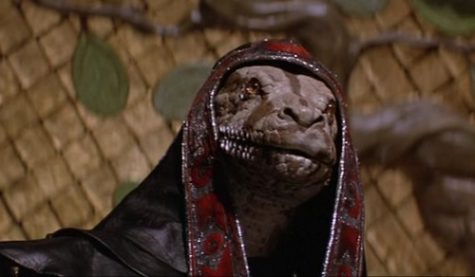
However, the tension grows as Doom is able to kill Valeria also, thus denying Conan of even his mother-substitute. The conflict finally resolves itself as Conan slays Doom using his father’s broken sword, severing his head and flinging it down the stairs of Doom’s temple. As the snake cult followers look on, Conan has asserted himself as the supremely dominant male.
Throughout the narrative of Conan, popular ideas of masculinity are challenged and reinforced regularly, reaffirming the patriarchal ideal of the dominant, emotionally despondent male. Women are objectified, subjugated, and discarded as tokens of sexual dominance and desire. Only through two female characters do we see actual intimate contact taking place, and even this is colored through a lens of repressed emotion, creating a distance between the characters.
As formerly detailed, the Oedipal narrative can be traced in its entirety through the various acts and adventures of the films namesake, finally reaching its resolution at the bloody conclusion. Although not a new film by any means, viewing Conan the Barbarian under a psychoanalytic lens still reveals many of the ideas and attitudes still common in our society over a quarter of a century later.
About the Author:
John Garlick is an English teacher with an abounding love of fantasy literature, films and video games.

Still A GOOD TAKE IN 2021!
I have seen several analysis of Conan movie mentioning his initial speech about enemies, their women etc.
But funny no one mentions those words are attributed to Gengis Khan . Also met by the fact Subotai, Conan’s companion name was taken out from a Gengis Khan clansman.
And I’m not the 1st to notice. Searching for confirmation I found this
http://www.barbariankeep.com/ctbsecrets.html
I have watched several Arnold Swartzenegger movies, but not this one. And I have to say – from reading your article, it is not the type of movie I would enjoy either 🙂 Something different for everyone…
Taranaich,
No, you are absolutely correct. The character portrayed by Arnold Schwarzenegger and the one painstakingly created by Robert E. Howard are very different animals indeed, and my intention was not to confuse the two. However, due to the wealth of material created by the latter, an article-sized psychoanalysis would be impossible…if I were writing my own book on the topic, that would be a different story. My interest was more to evaluate the sign systems that are universal within the human mind and even our culture, and to give aspiring authors some awareness of how simple artistic and creative choices can be opened and examined for further interpretation. At that, the film is succinct but sufficient tool.
Being a Robert E. Howard fan, it would be remiss of me to fail to point out that much of the (fascinating) discussion of the film has little to no relevance to Howard’s original character, at least in the form seen here. Howard never discussed Howard’s upbringing and early life in great detail, and what little we do know is contradicted by the film.
Case in point, the crucifixion. You bring up Jesus and Prometheus as analogues, but note that it’s different in this film, since Conan was crucified because of his own desire for vengeance, as opposed to Jesus and Prometheus, who were tortured because of a of desire to aid humanity. In “A Witch Shall Be Born,” Conan is crucified by a conspiring general after he (Conan) discovered his plot to usurp the throne and instill a brutal, corrupt regime. Conan saw through the deception, and had to be silenced. It’s not really that similar to either situation, but it’s more than just selfish reasons that got Howard’s Conan on the cross.
This is just one of multiple examples of Milius taking bits and pieces from the original stories and moulding them into his own narrative. What resulted was a fine film, but one very alien from the original stories.
Psychoanalytically, they have no good or evil symbolism. I think Freud stayed away from discuss the dual symbolism of certain objects…he simply made the obviously leap from phallic imagery to sexual power. You make a good point, though. Quetzacoatl, a Mesoamerican deity, was described as a winged or feathered serpent. Myself, I am more interested in religious and cultural parallels than differences…such as the flood, virgin birth, resurrection, and the existence of creatures we instantly recognize as dragons.
Thank you. 😉
I’m quite fascinated by the number of different beliefs surrounding snakes. In Christianity, they’re a symbol of evil, in some other religions they’re highly respected.
What does psychoanalytical theory say about the biblical snakes? Or is this a subject matter to broad to answer here?
But then again, as George said…sometimes an elemental snake is just an elemental snake.
Sarah,
From a psyhcoanalytical perspective (and keep in mind, this is more in line with the theory than my own beliefs), a female protagonist with a “snake-shaped” servant would establish her as a female character “equal to a man,” which Freud would say was based on the “penis envy” of her father from an unresolved Oedipal complex (he believed boys and girls both had unresolved sexual feelings with their mothers due to the closeness established between mother and child after birth. The “Elektra” complex was later coined by Karl Jung, and is theoretically a different facet of psychoanalyzation). This would enable her to achieve both power and sexual dominance. As for the “Elemental” part…what element? All elements can be by nature destructive, but some are viewed, for whatever reason, as leaning more towards masculinity/femininity, and obviously speaks volumes about your character’s personality. Keep in mind that psychology has come leaps and bounds since Freud’s time…
Very interesting. Even though I’ve never read/watched this story, and now, I don’t really think I’m going to. 😉
By the way, my female protagonist has as snake-shaped Elemental servant with her. What does that say about me. 😀
George,
Yes, reviewing your other posts, I can see that. Regardless, I’m sure there are others viewing this article with a certain
“What the heck-ness?”, and so your appropriately facetious comment gave me the opportunity to explain why critical theory belongs on a writer’s forum such as this. No offense was intended to your ability or intellect by my further clarification. I got quite a few laughs from your portrayal of Freud, and often feel the same way.
No offense taken. 🙂
I’ll admit, though, I’m baffled that some would think critical theory might not belong on a writers’ forum. I would think it would be one of the most natural things to discuss as a writer. But perhaps I look at things more as a reader rather than as a writer.
George,
I can’t help but agree. As a student of literature, there is absolutely nothing wrong with viewing a film and enjoying it for what it is, assuming that there are no deeper motive than what can be assessed at face value.
However, I would like to say that critical theory isn’t meant to imply that the author/writer of any particular piece of writing was thinking about these things at the time, but that the narrative structure and interaction of the characters lend themselves to an Oedipal narrative as a whole. Just as with Joseph Campbell’s “The Hero’s Journey,” not all films or novels really click with the theory…however, the pieces of this film really do click under a psychoanalytic lens.
My intention was to present an alternate means to view a classic fantasy film, and hopefully to give people some things to think about in terms of how they view plot and character when creating their own worlds. There are a number of critical theories in existence, all created with the intent of digging deeper into literature and how it reflects the author, the reader, and society as a whole.
John, I’m not disagreeing with you. I’m big into literary criticism myself. Don’t hold with Freud too much, but I recognize it as a way to analyze both books & movies.
Conan the Barbarian is my favorite motion picture, and this is a remarkable analysis. I think that the success of Conan is that it taps into certain primal drives. Thank you for sharing!
As Freud said, “Sometimes a big a** sword is just a big a** sword.” 🙂
And hear da lamentation of da women……