
If there’s one quality that seems to characterize writers, it’s our need for time alone. Time to think. Time to daydream, to play with our words.
History elevates the solitary writer as a kind of legend: that elusive genius, scribbling furiously in a forgotten attic, until at long last (usually upon completion of their magnum opus) they expire, penniless and unsung.
Public gratification, it seems, always comes too late.
Today, though it’s much harder to hide in any attic long enough to write a magnum opus, we still strive for that ideal. The penniless and unsung part, too, we also to accept as a matter of course.
But what if the two are related?
What if we turned our gaze to a different writer: one just as talented, but not solitary? This writer has cultivated an audience and is making an impact now. And his/her attic is full of other writers.
Already I hear bodies shifting uneasily in seats. Collaborate with another writer? Compromise on creative ideas for a mutual product?
Maybe that penniless and unsung part isn’t so bad after all.
My Story
Five years ago, talk of collaboration always made me nervous. Sociability has never come easily. While I’ve learned to “turn on” the social butterfly at events, I still find the simplest lunch appointment exhausting. Communal working environments are even more complicated, especially when it comes to my fantasy tales.
For years I wrote Great American Fantasy Novels in the solitude of my home or a coffee shop. If I worked with a mentor or writing group, I’d bring my pages on the appointed day, take copious notes, then go back to my cave to revise my work . . . alone.
More experienced scribes began urging me to find a writing partner. “You’ll improve so much more quickly,” they assured me. “Many professional writers get their start this way.”
So I tried a few. But even if I liked the other person and his or her style, something about the personal interaction just didn’t click. On that excuse, I retired to my cave once again to pen Great American Fantasy Novels . . .

Until the day I couldn’t.
Last October, sick of my own fears about sharing my work, I started serializing one of my novels on the web. I knew enough about internet viewing trends to recognize that nobody would read a big book, no matter how compelling, without some pretty visuals to draw them in.
So I reached out (hesitantly) to a few local artists “Would you do a quick sketch for a chapter?” I asked. “Just one?”
The Big Change
Suddenly my far-flung creative planet was joined by others in its lonely orbit. These artists, some of whom also turned out to be writers, brought a fresh perspective to my story that I never could.
Before I knew it, I was co-writing other projects with them: short films, comic books, interesting genre hybrids. But these collaborations were different from my writing group or previous attempts at team writing. I noticed significant changes in my work:
- My perfectionism and fear of criticism subsided.
These two qualities had run rampant inside my solitary attic, wreaking havoc on my ability to produce work in a professionally viable way. Now, thanks to my co-writers and artists, I received regular feedback by people who cared about the story, and also cared enough about me to call me out on my fears. - My creative output increased.
Two brains work faster than one. With collaboration, I doubled my available experiences and expertise. My weaknesses as a writer were balanced out by another’s strengths. Suddenly I was finishing projects and getting them out the door to an audience rather than dithering around with no sure direction. - The quality of my work skyrocketed.
By the time a collaborative project was finished, it had undergone a preliminary “vetting process” by other minds. I could feel more confident sharing these stories with others. And the general audience response to them more than proved my point.
Of course there were some legal considerations. My co-writers and I had to agree on joint ownership and set clear expectations. And there were some projects that I continued alone in the solitude of my attic.
But overall, collaboration transformed my approach to my writing work, even my fantasy tales. If my journey had ended there, I would have been more than satisfied.
It’s Not Over Yet . . .
But this past April, the weekend I finished the serial, I got an email from Theatrics. This innovative company is best known for launching the world’s first interactive TV show, Beckinfield, about a small California town with big paranormal secrets. Anyone who wanted to, from professional actors to brand-newbies, could create a character and tell the story through video posts.
Theatrics had seen my serial and wanted to know if I would design a show like Beckinfield, based on my fantasy world.
To do it, I’d have to collaborate with a brand-new co-writer: my audience.
“Wait, let me get this straight,” I said. “You want me to build a story, hand the keys to an undetermined number of people I’ve never met, and let them drive my creation right off the lot?”
Right then and there, my Inner Loner reared her head. Big time.
But at some point, I realized this type of story did have some boundaries to keep actors on track. And beyond that, my journey into collaboration thus far was just a reflection of changes across all entertainment. Audiences want to get out of the armchair and into the action. There will always be a big audience for traditional media like books and films. But why not also give this new method a try?
If I was committed to collaboration, this was the logical next step.
As you’re reading this, the resulting show, called Aurelia: Edge of Darkness, just launched its beta. I can’t give you a “rousing success story” (yet) about how my audience and I made the next internet sensation. And hey, in twelve weeks, I might have to admit it totally flopped. Who knows?
But if I’ve learned anything thus far, I’ve learned that the process of collaboration is its own art. Even if the final product isn’t quite what I hoped, perspective will rub against perspective along the way, showering sparks that fuel many creative fires to come.
I’ll take that over my solitary attic any day.
* * *
What about you? How do you leverage collaboration to enhance your writing work? Share your tips and ideas below!
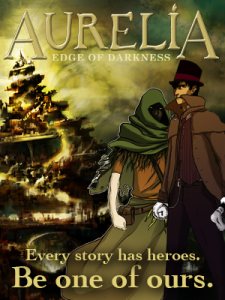
And while you’re at it, if you’d like to check out Aurelia, or even dive in as an actor, email me at [email protected]. The beta show is private; once enough “citizens” enter the world, we’ll go public (sometime in July). In the mean time, I’ll be happy to send you the invite link to take a peek. When you arrive, just look for the crazy girl in the purple shawl. That’s me!

Just wanted to thank everyone who took time to read this post! I’m happy to report that AURELIA: Edge of Darkness has enjoyed a successful two-week beta. In fact, our partner Theatrics is so happy that they have moved our press launch up a full week. We’re now launching our public site on July 17th! This means everyone will be able to view the show and participate. Stay tuned . . . Every day, every actor, and every story is a miracle. So thankful!
You do have a talent for great writing style! I have to admit I am also a loner, and a perfectionist. Being too worried about whether our work is perfect or the ‘best’, is not usually the most important point. Having other people like and enjoy our work should be our key goal. I tend to make sure I like it myself, but then get scared about letting my stuff out in public to be freely ‘praised or criticized’. Great job on the collaborative effort, glad to hear it’s going well!
livin4mydream George R.R Martin once said a piece of truth which stuck onto me ever since. In short, art isn’t democracy and it should never be. And what is art? Art is the humane way of expression, a sense of flawed beauty where self-perfection is the key rather than whatever demands placed upon others. So long as you see your work as a form of art rather than just a money making tool, then you’ve got yourself the correct attitude. As we the Chinese like to say, it takes a hero to know another hero. 🙂
To be personally getting an email from Theatrics and even be offered to have a show designed from your novel, you shouldn’t be worrying how it will pan out. It clearly shows you have great potential, and it is undoubtedly a stepping milestone on your part!
@Donald – Thank you for your kind words, Donald. The show has been live now for just a couple days, but we’ve been overwhelmed at the response from interested actors. And (just as I figured) things are already taking a different turn than initially intended, which means lots of learning ahead!
It can be hard to accept people injecting their stuff into your content; it happens to everyone in the creativity industry. But collaborating with people actually allows more perspectives, that may even be better suited than yours. The professionals are professional for a reason. 🙂
@Joanne Evans – Good point, Joanne! I think it’s a challenge for most writers to learn the humility needed to allow someone else to speak into our work and maybe even provide a better idea. (At least, I know it is for me!) But by exercising and cultivating that discipline, we open ourselves to an even higher level of craft and performance. The best professionals, I think, learn this secret and live by it. 🙂
In theory, it seems like a good idea but I am sure it had to have been very difficult to find just the right person, one whom you can work well with and throw ideas back and forth. I will have to keep searching for someone for me.
eds_garage – Great point! Yes, it takes time. It took me five years to find good collaborators. Don’t be discouraged! Keep searching. And above all, keeping trying out collaborators. Some of the people who ended up becoming my best collaborators are so vastly different from me that I would have written them off as a “no-go” for collaboration a couple years ago. All I can say is: be patient. Experiment. Have fun meeting people, and don’t get too stressed when a trial collaboration doesn’t work out.
RiseOfTheTiger eds_garage Thanks for the tips! I will have to keep trying. 🙂
I’m currently collaborating with a friend on a project, and it’s going extremely well. Together we are coming up with ideas that we would have never have thought of on our own. I’m excited to see how the book turns out.
@Tony Dragani – Congratulations! I’m excited for you! Keep us posted on the progress. I had a collaborative writing session today with one of my artist friends who also does comics. I proposed a story idea a few weeks back, and we’re currently roughing it out. Just like you said, we’re also coming up with ideas together that we could never have arrived at separately. It’s a lot of fun.
To me, collaboration will only work if you know what that person is capable of. Collaboration must be done firstly and foremost with the professionals who view writing as an art. Only after that can one progress further to collaborate with the audience. One of the biggest dangers in current writing world is this: people tend to assume 90% of the global populace are intelligent enough to know what is 2+2 and that includes themselves. As a writer (?), I firmly believe that if you want your works to be judged, make sure you let the professional critics do it for you. People who understand literature, people who understand the cynical truth called Executive Meddling.
KuokMinghui – Thanks for your perspective! I agree that it’s very helpful to work with professionals who have a high view of writing as art. It’s interesting, though … I’ve usually found that those same professionals don’t want to work with a brand-new writer who’s never honed their skills at collaboration. In the entertainment industry in general, young writers hone their skills by working with other up-and-coming writers — and it’s often through those relationships that they attract the notice of professionals. Collaborators must be chosen wisely, of course, but a good collaborator helps you double up your network of professional contacts (and vice versa) … so you can start collaborating with professionals. Just a thought. Thanks for checking in!
RiseOfTheTiger KuokMinghui Good point there. But I need to add in something here: different authors have different perspectives, different authors will view another author somewhat differently.
If collaboration is a must and the writer hopes to do so with so-and-so up and coming writer, we must also understand that different professionals have different standards.
What is the standard of your ideal author to collaborate?
How do you gauge the standard?
What kind of professional writer are you gunning for in terms of getting noticed?
I can easily say I’ll like to attract the attention of writing titans like Sir Terry Pratchett, J.K Rowling or George R.R Martin just to give an example, but which up and coming author(s) should I choose first before that big break?
KuokMinghui RiseOfTheTigerNever limit yourself. That’s the real trick. If you make yourself available to any sort of author, chances are due to the general circles they frequent it may very well reach the big names, if your work is good enough. You could easily reach out to say, a children’s books writer or romance novelist and they may very well know someone in your respective genre that you never thought of.
KuokMinghui – Great questions! I asked those same questions, too. I found that the only way for me to find out the answer . . . was to try out collaborations. The longer I asked myself the questions (and put off reaching out to work with people), the longer I waited to find out my answer.
It’s true, you can’t gauge who’s going to be the next rock star. And I don’t really advise going into a collaborative relationship, putting the other person under that kind of pressure, even secretly.
But that being said, you probably do know what you value and respect in another writer. You probably know what “winning” qualities you want to see in a fellow writer who has the stuff it takes to success.
As you test collaborations with those you think may have those qualities, you’ll find out who does and who doesn’t have those skills. There’s no shortcut here to trial and error, that I know of. The best collaborations will “stick.” They’ll stand the test of time. And whether or not that collaboration ends up getting you your first “big break” — it will help you hone skills you’ll need, to get and survive success, together or alone.
Hope that helps! Best wishes with your writing, whether alone or with others!