• Welcome to the Fantasy Writing Forums. Register Now to join us!

"Swords aren't Lightsabers"

Alright, I see the point (though I'd like to read that article if someone can link it here) but um, what about fictional metals?
In my story there are, bout two through five purely fictional metals each varying in strength and having different use cases for swords.

For example one such metal is extremely magnetic, when forged properly it can be used to create some of the more silly fictional swords. Like those silly chain swords we see sometimes. Thing is you need mana to make the 'magnet' work, otherwise it's just a hunk of steel-esque metal that's maybe...twice as durable? It's also quite light, a pound of the stuff would feel significantly lighter than a pound of ordinary steel. Swords made with the stuff require a deft hand and a strong arm, cause if you're not careful the magnet will pull you along with it.

Then there's Black Sand Steel, forged from the snow white mineral 'sand' found in my desert region. It's called black sand steel because when the sand is smelted at extreme heat (and by extreme, I mean dragons breath, or something similar) it becomes...basically carbon, but a lot harder to 'break' through normal use. It's rarely used for proper 'swords' but it's commonly used for cooking tools, and medical tools notably for bone cutting. Not gonna stop a more esoteric swordsman/woman from trying to make a proper sword outta the stuff though.

Then there's Blue Light, it's a 'metal' forged by smelting down a natural stone that emits a bright blue glow in pitch darkness. Due to it's rarity it's commonly used to forge Gems for the ends of Staffs (And earrings etc) but it's sometimes used as highlights in a blade's eight fold pattern, makes it look super cool and also very reactive to light magic. Good for banishing demons and killing vampires if they become a menace. (Not that the vampires are particularly 'evil' in my story, there are some bad guys though)

Then there's Shinespark (Yes I'm stealing this from metroid terminology, hush): It is not often used to make a 'complete' sword, but rather it is layered into the cutting edge to make it razor sharp. The stuff turns just about any cutting tool into a deadly weapon, but it's also very hard to work with. Cause if you apply mana to it, it stores it on the edges and when struck, kaboom. You'd have to be either very skilled or slightly insane to use a blade lined with the stuff, but hey, it's cool.

Least remarkable of these is Steel Bamboo (name pending, still working on it): It's basically just bamboo that has some of the properties of steel. In a pinch, it makes a fine cutting tool or makeshift sword, but considering it's actually a plant, it's not very durable, also it's combustable. Commonly used by the fae folk in their armor and weapons.
 

pmmg

Myth Weaver
I am not sure the question. If they are fictional metals, then I guess they have whatever properties you say.

I doubt anyone will investigate further, but Steel has its reputation, not so much for strength, but for it flexibility. It can bend and give and come back to its original shape. Many other metal cant do that.
 
I am not sure the question. If they are fictional metals, then I guess they have whatever properties you say.

I doubt anyone will investigate further, but Steel has its reputation, not so much for strength, but for it flexibility. It can bend and give and come back to its original shape. Many other metal cant do that.
I mean, swords are swords, so regardless of the fictional metal involved I imagine SOME of the sword logic would apply?
I just don't know what I should apply, these metals are fairly 'broken' if I just let them be ya know, insanely cool.
I need to add some kind of weakness or something to them. (except maybe the bamboo one)
 

pmmg

Myth Weaver
Well. No they arent. Thats thats why there are so many different types of swords.

An iron sword will kill you, sure, but its not as good as steel.

Anyway. Weaknesses typically come in the form of weight, flexibility, cost, brittle aspects, difficulty to work with, and rareness of material.

Look into those.
 

skip.knox

toujours gai, archie
Moderator
Much depends on the author here, though the reader bears some of the load.

On the author's side, expectations must be set. This can happen intentionally or accidentally; that is, the author can provide sufficient information via narrative and dialog, to make it clear that these particular swords have special properties. The reader then know what to expect. All too often, however, the expectations are not set but are assumed. The author talks about iron or steel as if it never needed sharpening, or did not get bent or nicked. Or whatever. If the sword is really just a steel light saber, then say that. But when the author fails to do this, then the reader is justified in crying foul and giving the book airplane tryouts.

So much for the author. On the reader's side, though, it is possible to have incorrect expectations. The reader may well not have a good understanding of metallurgy or sword play or human physiology. In those cases, no matter how clear the author is, the reader goes in the wrong direction. This is most likely in the case where the author fails to set clear expectations, but it can happen even despite this.

It's worth pointing out that this happens in a zillion cases (formal count pending). We're familiar with these. Unrealistic horses, military logistics, political structures, and on and on. And just as it's unrealistic to expect an author to be well-versed in just about everything, it's also unrealistic to expect that of every reader. This is something I try to keep in mind in my own writing. In many cases we can let this slide. The more important the point of detail is to the story, the more incumbent it is on the author to do their research. And to write clearly. After that, well, readers vary.
 
Much depends on the author here, though the reader bears some of the load.

On the author's side, expectations must be set. This can happen intentionally or accidentally; that is, the author can provide sufficient information via narrative and dialog, to make it clear that these particular swords have special properties. The reader then know what to expect. All too often, however, the expectations are not set but are assumed. The author talks about iron or steel as if it never needed sharpening, or did not get bent or nicked. Or whatever. If the sword is really just a steel light saber, then say that. But when the author fails to do this, then the reader is justified in crying foul and giving the book airplane tryouts.

So much for the author. On the reader's side, though, it is possible to have incorrect expectations. The reader may well not have a good understanding of metallurgy or sword play or human physiology. In those cases, no matter how clear the author is, the reader goes in the wrong direction. This is most likely in the case where the author fails to set clear expectations, but it can happen even despite this.

It's worth pointing out that this happens in a zillion cases (formal count pending). We're familiar with these. Unrealistic horses, military logistics, political structures, and on and on. And just as it's unrealistic to expect an author to be well-versed in just about everything, it's also unrealistic to expect that of every reader. This is something I try to keep in mind in my own writing. In many cases we can let this slide. The more important the point of detail is to the story, the more incumbent it is on the author to do their research. And to write clearly. After that, well, readers vary.
I was thinking of having it that plain 'ordinary' steel is almost gone in this world, because magic had changed various remaining veins of it (Iron) into the different minerals (More than the ones mentioned above, but the ones mentioned above are actually featured in the story and slightly related to one character's plot.) in this thread. Other metals like Gold and Silver are far more common, heck you can break a random rock and find a lump of carbon (Yes I know carbon isn't one mineral but in this story it is) and if you're lucky, might even chance upon good old Mithril. Though in my story it is notoriously difficult to work with.

You'd have to be either really rich or really stupid, potentially both to go to the places where there's still regular steel/iron to mine.

I've decided to include a Mage/Blacksmith in the story (he's part of the main party) to give me an excuse to explain the crazy metals.
 

Malik

Auror
You'd have to be either really rich or really stupid, potentially both to go to the places where there's still regular steel/iron to mine.

You don't mine steel. Steel is iron ore, heated and mixed with charcoal (carbon). Steel is not naturally occurring. God, I wish more authors would figure this out. (You're not the first; I read this in Big Fiction every so often, and in indie fantasy fiction so many times I've lost count.)

Video on making steel. I've done this, by hand, as research for my series.


The second half of this is heating the blister steel back up and beating the shit out of it for a few hours with a hammer, folding it over and flattening it to spread the carbon (the blisters) as evenly as possible through the iron. Think of it as mixing bread dough; bread dough that's rock hard and 1800F. With a hammer.
 
Last edited:
You don't mine steel. Steel is iron ore, heated and mixed with charcoal (carbon). Steel is not naturally occurring. God, I wish more authors would figure this out. (You're not the first; I read this in Big Fiction every so often, and in indie fantasy fiction so many times I've lost count.)

Video on making steel. I've done this, by hand, as research for my series.


The second half of this is heating the blister steel back up and beating the shit out of it for a few hours with a hammer, folding it over and flattening it to spread the carbon (the blisters) as evenly as possible through the iron. Think of it as mixing bread dough; bread dough that's rock hard and 1800F. With a hammer.
re reading it I realize what I said, but I kinda misphrased it cause I was very eepy at the time.
Yes obviously steel isn't an ore, Iron itself is the thing that's almost gone from my magical world. Coal is still common, and there's similarly magical variants of coal (just like how there's metals and ores that have properties of iron but are magical) in fact what makes the magical variants of iron so hard to work with is that the magical variants of coal that work with the right irons. The magical coal is a main export of the stone bloods, they typically deal with the rich nobles and royalty. So it's very hard for commonfolk to have any of these magical irons (except maybe the bamboo, since it's just a natural plant that grows)
 

Malik

Auror
re reading it I realize what I said, but I kinda misphrased it cause I was very eepy at the time.
Yes obviously steel isn't an ore, Iron itself is the thing that's almost gone from my magical world. Coal is still common, and there's similarly magical variants of coal (just like how there's metals and ores that have properties of iron but are magical) in fact what makes the magical variants of iron so hard to work with is that the magical variants of coal that work with the right irons. The magical coal is a main export of the stone bloods, they typically deal with the rich nobles and royalty. So it's very hard for commonfolk to have any of these magical irons (except maybe the bamboo, since it's just a natural plant that grows)
And again--please read my earlier (years earlier) posts on this--if there was some kind of super-steel, you wouldn't have medieval martial arts in any form that we'd recognize today. Literally nothing that soldiers developed throughout history would work. You'd need to invent an entirely new martial-arts system; probably several of them. That is, if you wanted your book to make sense. A lot of fantasy authors skip over that last part, and that's fine, too.
 
You don't mine steel. Steel is iron ore, heated and mixed with charcoal (carbon). Steel is not naturally occurring.
Isn't one of the theories surrounding the Viking ulfberht swords that the iron used in them was mined from a region in India which had a relatively high proportion of carbon in it, making it a natural steel (or closer to it than usual at least)?

Japanese iron is the exact opposite. The reason you fold your iron a million times (or whatever) to make a katana isn't because Japanese blacksmiths are bad-ass and like the cool look. It's pretty much the only way they can make some half decent iron/steel out of the crappy stuff they mine (or gather, I think they use some weird river sand which is high in iron).
 

Malik

Auror
Isn't one of the theories surrounding the Viking ulfberht swords that the iron used in them was mined from a region in India which had a relatively high proportion of carbon in it, making it a natural steel (or closer to it than usual at least)?
I haven't heard this. It's possible, but the trick is to get exactly the right amount of carbon in your iron for the task at hand. 0.50-0.65% is widely considered ideal; however, the characteristics of 0.50% carbon steel (mild steel) and 0.65% carbon steel (surgical steel) is considerable.

Also, to my knowledge, Viking swords were made with high-carbon steel edges welded (folded into) a spine of braided iron bands. This gave their weapons ductility and "spring"--a plain iron sword will bend like a wet sock if you hit something wrong, and that kind of flexion could crack the steel edge if it had one. Similarly, a solid high-carbon sword would chip or even snap in a fight. (Drop a straight razor on a marble countertop and it's ruined.) My understanding is, the Norse developed this method to make their swords sharp and tough as hell before Europeans had caught on to the technology.

These days, reproduction swords--and really good knives--are differentially hardened. They're one piece of steel, but the edges are harder and the spine is softer. Same principle, but I believe the Norse were doing it long before anyone else we know of.
 

Mad Swede

Auror
Isn't one of the theories surrounding the Viking ulfberht swords that the iron used in them was mined from a region in India which had a relatively high proportion of carbon in it, making it a natural steel (or closer to it than usual at least)?
Ulfbehrt swords are made of steel which has a high carbon content (about 1.8 - 2.0%), which makes the blade both strong and flexible. This sort of steel is known as wootz and the technique for making high carbon steel of this sort is thought to have to Europe come from India via Viking trading with the Byzantine Empire. It is the way the steel is made which gives it a high carbon content, not the iron ore used (which ideally should be low in impurities). The swords themselves are thought to have been made in Europe (probably in the Carolingian Empire) using locally produced high carbon steel during the period AD800-AD1100.

Ulfbehrt swords were very expensive, so not many were made. (A total of 171 swords of this sort have been found.) Quite a few cheap copies were made, some of which may have had steel edges made of high carbon steel.
 

skip.knox

toujours gai, archie
Moderator
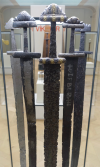
I was fortunate enough to visit Oslo briefly some years ago and happened on a museum there (the historical museum, not the ship museum). I have a strong memory of one section being entirely of Viking stuff, including a good dozen or more swords. I was surprised to see how small they were, with a blade maybe three feet long or less, and in what poor shape they were. The blades were notched, some were bent. I just did a search and found pictures; am reassured my memory has not tricked me.

Turns out those are indeed ulfbehrt swords. Some of what I see is corrosion, but other blades have been snapped off or are otherwise damaged.

So, would I be correct to assume that ordinary steel swords--however you define ordinary--would be in even worse shape? Here's a picture, to illustrate. What I remember was a much less grand display, in a smaller and darker room, but probably they've remodeled since I visited.
1766089982856.png
 

pmmg

Myth Weaver
I dont think the OP'er was unaware that Iron is mined and Steel is a combination of Iron and carbon. And yeah...Steel is a great material for a lot of reasons. But...in fantasy worlds there are oft times fantasy metals. They may be cool for all the wrong reasons, but I will go with them. If you say Mithril is better than steel, I'll accept.
 

Mad Swede

Auror
I was fortunate enough to visit Oslo briefly some years ago and happened on a museum there (the historical museum, not the ship museum). I have a strong memory of one section being entirely of Viking stuff, including a good dozen or more swords. I was surprised to see how small they were, with a blade maybe three feet long or less, and in what poor shape they were. The blades were notched, some were bent. I just did a search and found pictures; am reassured my memory has not tricked me.

Turns out those are indeed ulfbehrt swords. Some of what I see is corrosion, but other blades have been snapped off or are otherwise damaged.

So, would I be correct to assume that ordinary steel swords--however you define ordinary--would be in even worse shape? Here's a picture, to illustrate. What I remember was a much less grand display, in a smaller and darker room, but probably they've remodeled since I visited.
View attachment 4099
The wootz steel used in Ulfberht swords has a very even distribution of carbon and it is this which makes the steel strong and flexible. Given the technology of the day making wootz steel would have required smelting and resmelting the steel several times in small batches, hammering the steel bar out between each smelting. This took time and skill, because wootz steel would have been much harder to work than the sort of steels most smiths were used to. All this made for a very exclusive and very expensive blade.

"Ordinary" steel swords would have had an uneven distribution of carbon and other impurities in the steel. This would create flaws and areas of weakness in the blade as well as making it much less flexible, so making the blade more likely to break under strain. So yes, such blades would be in worse shape if they have survived at all.

As for the length of Viking swords, most were a little under a metre long. The blade itself was slim and double edged, about 70-90cm long. They were intended for use together with shields (so they are a one-handed weapon, hence the lentgh) and were mostly used for hacking and slashing at the enemy.
 

pmmg

Myth Weaver
I was fortunate enough to visit Oslo briefly some years ago and happened on a museum there (the historical museum, not the ship museum). I have a strong memory of one section being entirely of Viking stuff, including a good dozen or more swords. I was surprised to see how small they were, with a blade maybe three feet long or less, and in what poor shape they were. The blades were notched, some were bent. I just did a search and found pictures; am reassured my memory has not tricked me.

Turns out those are indeed ulfbehrt swords. Some of what I see is corrosion, but other blades have been snapped off or are otherwise damaged.

So, would I be correct to assume that ordinary steel swords--however you define ordinary--would be in even worse shape? Here's a picture, to illustrate. What I remember was a much less grand display, in a smaller and darker room, but probably they've remodeled since I visited.
View attachment 4099

Even with Ulfberht, I am sure there were some that were not of the same quality as others, and there were probably knock offs and pretenders. And...anything used enough, took damage. If these were found on a battle field, perhaps they were found because they broke, and the better swords moved on to a different battle.

Which is to say, is the sample above representational of the whole?

I dont know...even if I had a modern sword with great steel, if I left it buried in the mud for a few centuries, it might not look so good.
 
Top