
This article is by Anne Marie Gazzolo.
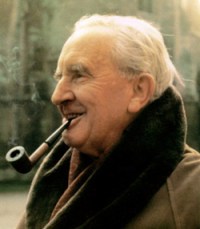
In the essay, “On Fairy-Stories,” J.R.R. Tolkien speaks of a subject close to his heart. He had a life-long interest in and love for the genre, and approaches the topic as an author.
According to Tolkien, fairy-stories allow us as readers and authors to experience what he calls recovery, escape, and consolation. In our broken world, we need all three.
Such affords us the opportunity to profoundly change the way we view ordinary things and life itself.
Seeing the World Anew
The world of Faërie does indeed have all the things we are used to seeing, as Tolkien notes: “the seas, the sun, the moon, the sky…tree and bird, water and stone, wine and bread, and ourselves, mortal men, when we are enchanted”.
But we see these things in a new way while we travel through strange lands that at times become home to us.
We do not see merely a sea but the Sea and all that means to those who live near it or travel upon it. Wine and bread mean more to us when they are shared between heroes. Such has been dipped into the Cauldron of Story, and we savor the flavors that come from such a rich and heady mixture.
Can we look at a horse again the same way after encountering one in the world of Faërie, or look at the moon and not think of those we have met doing the same?
Escape from the Culture of Despair
If we are open to the potent power of the Faërie kingdom, it changes us, improves our outlook, and sharpens our senses. While the spell lasts, we do not see, touch, smell, hear, or taste things in the same way we did before.
We escape from the culture of death and despair that surrounds us, and enter a world where the same may hem the heroes about, but where they do not surrender to it. Such gives us the strength not to be overwhelmed ourselves.
If we are lucky, the magic does not fade after we reluctantly return to the Primary World, but is incorporated into our everyday life to enliven and enrich it.
We look at a sunset with new eyes and really smell the air after a spring rain. We recover the joy of children playing in the snow and catching flakes on their tongues.
The Consolation of the Happy Ending
Along with recovery and escape, another great gift from the realm of Faërie that we can give ourselves and our readers is, as Tolkien calls it, “the Consolation of the Happy Ending”.
He coined the term eucatastrophe to explain what he meant and calls it “the true form of fairy-tale, and its highest function”.
We desperately need to know that even if everything is falling apart around us, and all seems headed to disaster, that we can still experience the “sudden joyous ‘turn’” that saves our lives from utter ruin. Fairy-tales teach us this is possible.
Those who scoff and say “That only happens in stories” have not had the consolation of such eucatastrophic joy themselves. They do not realize such is possible in the Primary World. But it is.
Has entering the Perilous Realm of Faërie through stories affected you? If so, how?
About the Author:
Anne Marie Gazzolo is the author of Moments of Grace and Spiritual Warfare in The Lord of the Rings, which includes a chapter on The Hobbit. It is available from WestBow Press. You can also visit her site at annemariegazzolo.com, and can connect with her on Facebook and Pinterest.

That is actually a very good essay that I haven’t read in a while. I think it’s time to revisit it and have a good read.
Glad I provided the inspiration to do so! It is indeed a great essay. 🙂
Namarie, God bless, Anne Marie 🙂
I use books and movies as a way of escaping reality for a while and just relaxing. I like real life stories more than fairy tales, but I do want a happy ending of sorts, even if it is not the ending I wanted or expected. When the ending is sad, it kinda leaves me with an unfinished feeling, like what was the point of the story if not for a happy ending? Real life doesn’t always have happy endings – that is why I want to be able to enjoy happy endings when I’m reading a book or watching movie; to get away from the world for a bit.
I like happy endings too, even if the ending is unknown and only hoped for like it is for Frodo, who appears to have a sad ending, but that’s not the end of his story. Thanks for your thoughts!
Namarie, God bless, Anne Marie 🙂
I wouldn’t make too much of this. There are plenty of “downer” stories from earlier decades, earlier centuries, even earlier millennia. Even within fantasy, the most I would say is that we’ve become a bit Shakespearean (though we are to remember that both Lear and Hamlet were based on older tales).
Beyond that, I will quote the wise poet: Still, a man hears what he wants to hear and disregards the rest.
@Skip Knox Thanks for sharing your thoughts, Skip.
I’m a member of “generation x”, and came of age during the grunge era in the 1990’s. Yes, there will still happy, upbeat songs during that period, but the cynical pessimism that characterized grunge pervaded popular culture.
While it may not be the dominant trend today, it certainly appears that some of that “grunge era” pessimism has left a lasting imprint on some forms of entertainment.
Could that be characterized as “Shakespearean?” Probably. Depressing endings certainly have their place.
But Shakespeare’s tragic endings always had a point: some fatal flaw inevitably led to the character’s demise, or the demise of innocent third parties (Romeo and Juliet). In other words, Shakespeare’s tragedies fit into a larger worldview in which things made sense.
On the subject of the pessimistic world view, I think history will always be cyclical – high points and low points. We had ancient Greece for an intellectual and philosophical high point and then Rome for a technological high point, and then we sank into the Dark Age, which morphed into the Renaissance with its resurgence of the intellect and wonderful art and music, which led to the Age of the Enlightenment and ultimately to another upsurge of technology – the Industrial Revolution. Now, starting with the atomic bomb, we are in the Age of Science Fiction (that’s my term). Unfortunately, it’s leading to the worship of technology. In my future history, the cycles continue. We have a Second Dark Age, followed by a second Renaissance where we achieve interstellar travel, where real science is more important than technology, and where humanity finally learns that we must all be “human” – an Age of Humanism. See, I refuse to be totally pessimistic, even though I recognize that humans will continue to be imperfect and Utopia will never exist.
This is a great article… I have added it to my notes with proper credit to the author and Mythic Scribes. Thank you for your excellent e-zine.
@The Abbottsford Cats I am glad you liked my article!
Namarie, God bless, Anne Marie 🙂
Thanks for the excellent post, Anne Marie.
When thinking about the power of fairy stories, especially the “consolation of the happy ending,” I can’t help but think how much of today’s fantasy is the antithesis of this.
Do you (or anyone else) have any thoughts as to why “downer fantasy” is all the rage right now?
Antonio del Drago – Great observation. Perhaps it has to do with the general zeitgeist of our age? People seem down about everything in general: politics, science, culture, the future. So much talk of apocalypse. So much cynicism. Perhaps all this “downer” fantasy expresses a sense of rage or hopelessness people feel, as if they are powerless to change things — which is exactly opposite of the perspective of “positive” fantasy which focuses on the destiny of heroes. Personally, I also have thoughts about the correlation of happy endings with an overall worldview that allows for redemption and hope. Writers like Tolkien distinctly based their work in their worldview, after all. Just my immediate thoughts.
RiseOfTheTiger Very good point, Lisa.
I think that sense of hope and belief in a better future that characterized past generations has faded, and has been largely replaced by a bleak pessimism.
Tolkien believed that all of creation would one day be redeemed and made whole. In contrast, the dominant worldview in our era is that history is an endless cycle of destruction and suffering, with no positive end in sight.
Antonio del Drago – Excellent summation. Personally, for me one of the greatest attractions of writing fantasy is its allegorical aspect that allows for expression of personal belief in ultimate worth, destiny and redemption.
Antonio del Drago Thank you, Tony! I am glad you liked the post and I’m glad to be here. Honestly, I have not kept up with current fantasy, but certainly we are drowning in despair and pessimism in the Primary World and this is all some people know. We so desperately need escape and consolation like Tolkien has provided for decades now. Hopefully others will take up the torch!
Namarie, God bless, Anne Marie 🙂
Great thoughts. Thanks for sharing — especially the power of a happy ending. (Or at least, as I like to put it, a “hopeful” ending.)
RiseOfTheTiger Thank you! I am glad you enjoyed. We so need hope these days!
Namarie, God bless, Anne Marie 🙂
Tolkien really nailed it. I haven’t read his essay all the way through (yet), though I’ve read a lot about it as well as some parts of it. I like how you sum up the main points in an easy and concise manner. The eucatastrophy, escape from our day-to-day culture, seeing the world in a new light….these are what make well-written fantasy or “fairy-stories” so meaningful.
Sarah Hood Thank you, Sarah! This is my favorite of the Professor’s essays. I’ve read it several times and continue to enjoy it each time. He is a kindred spirit. 🙂
Namarie, God bless, Anne Marie 🙂
I don’t write stories about faerie, but I’ve always been influenced by Tolkien’s remarks in that essay. Any fiction that strives to be more than a light escape needs to make us look at reality in a new way. And a eucatastrophe doesn’t necessarily mean a happy ending. It can mean a resolution, a reconcilation, a positive outcome growing from a tragic or painful situation. I use that aspect a lot in my writing.
Lorinda J Taylor All those sound like happy endings to me! 🙂 Glad you use such things.
God bless, Anne Marie 🙂
I’ve read On Fairy Stories, and I loved it. I especially love his third point, the eucatastrophe. I think it gives authors and readers hope in the turn of events, that things can get better even when they look so bleak. We like it when this happens in fiction.
Jessica Flory And we love it when it happens in real life too! 🙂 I love Tolkien’s essay too.
Namarie, God bless, Anne Marie 🙂