
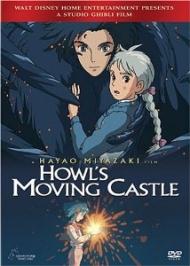
Howl’s Moving Castle by Diane Wynne-Jones was one of the first fantasy books I read. I bought it at a book sale at school, and loved it right away. Since then, I have bought it a further two times, after previous versions got lost or were lent to someone and never returned.
Because Howl’s Moving Castle has always been one of my favourite books, and because I had enjoyed films such as Spirited Away and Kiki’s Delivery Service, I was understandably excited when I learned that Hayao Miyazaki of Studio Ghibli was making a film adaption.
The Film
After months of eager and impatient anticipation, when I finally watched the Miyazaki film, I came out of the cinema disappointed and angry.
It wasn’t right. What happened to the whole Wales thing? Why was the true antagonist changed so drastically? What was with the flying warships? And the whole thing with Howl turning into a huge bird—what was that even about? The whole story had been changed, and the further along it went the greater the gulf between the book and the film. I hated it.
I have seen the film a few times since, and my dislike faded but did not vanish. It was still too different, trading on names when really it was more an invention of Miyazaki than of Wynne-Jones. Don’t get me wrong: film adaptations of books do not have to adhere perfectly to the books they are based upon. Film is a different medium, with different audiences and different aims. But the trick is in knowing what to cut, and what to keep. A good example of this, in my opinion, is Inkheart, another favourite book I read in my teenage years. The film of that worked well, even though there were a fair few differences between it and the book.

The greatest weakness of Miyazaki’s Howl’s Moving Castle is not the removal of Wales, or the addition of war airships, or changing the villain. It is in making Sophie boring. She has so much more to her character in the book. She is varied, she makes mistakes, she misunderstands situations and then acts on them in ways which mess things up. She thinks on her feet, says the wrong thing, and allows herself to be influenced by rumour and prejudice and misconceptions. In the film she has none of this. She is bossy and boring or sweet and boring. She has no agency. She does not worry herself sick about her sisters or misinterpret the situation so badly at the end that she causes the entire situation to get ten times worse. In Miyazaki’s version, she is merely swept up in a story which is more about Howl.
The Play
More recently, at the end of December 2011, I saw the new stage adaption of the book at the Southwark Playhouse in London. The play was short, little more than an hour, and recalling my disappointment with the film I went with tempered excitement. I knew beforehand that Stephen Fry narrated, which was impressive enough but not necessarily evidence of the play’s brilliance. I was concerned that too much would be cut out, and the essence lost, by the short duration of the play. And quite a lot of the story was cut out. Most of the characters—everyone but Sophie, Howl, Calcifer and the Witch—had been cut; and as a result, the storylines surrounding them.
What was left was the core: the relationship between Sophie and Howl, and that between Howl and the Witch. Their motivations stayed in place. The magic of the book was retained, albeit in a simplified form. The acting, too, was spectacular—especially that of the actor who played Howl, who had such energy and charm. The play was not the same as the book. It was more focused, less complicated, but just as fun. It worked, and remained recognisable as the same story.
Not the Book
Since watching the play, I have reread the book and reconsidered the film.
The film is not, on its own, a bad film. The story it tells is still exciting. Certain aspects of the story, such as the magical link between Ingary and Wales, may have had to be cut to appeal to an audience primarily comprised of Japanese and American viewers, whereas the initial appeal of the book, for me, was that I knew Wales—I live in an English county bordering Wales, and have been there several times on holiday. There are aspects of the film’s approach to the story, such as the flying warships, that are uniquely, even iconically, Miyazaki. Howl’s turning into a giant raven was, perhaps, Miyazaki taking a metaphor considerably further than Wynne-Jones chose to.
As a Miyazaki film, Howl’s Moving Castle stands up fairly well. As an adaptation of the book, it does not.
Final Thoughts
The book remains, and always shall remain, one of my favourite books ever. When I have children, I shall read Howl’s Moving Castle to them (hopefully the same copy I have now). I may never watch the play again; the run is over, and even if it is put on again, no play is the same twice. It remains a memory I shall cherish. The film, while not a complete failure, just is not on the same level. Mentally, I cannot categorise it with the book and the play, but only with other Miyazaki films.
Some of Alice’s ancient history articles can be found at perpetualpast.tumblr.com

I’ve seen the movie and read the book. I love both of them with the same amount..
I was surprised with the difference, but it wasn’t bad. they are 2 different stories each one has its own beauty..
actually, the part where howl participate in war was the most interesting part to me.. howl is my main focus in both the book and the movie, he is a very kind character in his unique way and it’s impressive how he can still be this kind while he doesn’t have a heart.. of course he has that childish act but he is serious when the situation needs.
in the movie I like how he cared about the destruction and how he wanted to play a part in stopping the war.
as for sophie, well I’m sorry to say that but though she is the main character she didn’t appeal to me not in the book nor in the movie, there was this weakness and self-destruction tendencies that she had which I didn’t like. that’s why I just focused with howl and his crew.
Sometimes movie adaptations just don’t work well. That is why they say it’s often better to see the movie first, so you aren’t expecting it to be like the book. It sounds like the play was great, though, and personally I adore Stephen Fry.
I can’t stand when movies take away from the book. There are some books to movies that do well, but it is extremely frustrating when important elements of the book are missing from the movie.
I’ve neither read the book nor seen the film but I am now interested enough to find a copy of this book in my local library. I know how much more interesting a story is when you know the place in which it is set, and I have never enjoyed a film more than the original book.
There is something about an anime book cover I just can’t handle. I know they say “don’t judge a book by its cover”, but I do not like the artistic view of anime. Then the characters end up being anime characters in my mind and the entire story is ruined.
I picked up this book last month and had forgotten all about having it tucked away. Now I want to see the movie, so I’d better get the book read pronto. I always like to read a book first, especially so in this case.
There have been very few occasions where I was not disappointed to see a film after reading a book. I find that my imagination does the job so much better, at least in my own mind. Normally, if I enjoy a book, I try to avoid watching the film and then I avoid the disappointment.
I enjoyed the Miyazaki film, but I’ve never read the book. At first I wasn’t sure if your criticisms sounded valid or not, but then I read this:
“The greatest weakness of Miyazaki’s Howl’s Moving Castle is not the removal of Wales, or the addition of war airships, or changing the villain. It is in making Sophie boring.”
Sophie *is* rather boring in the movie. She under-reacts to a lot of extreme situations, and I never felt like she was developed enough before she got swept up in the story, so I didn’t have a strong grasp of her character. Therefore, I couldn’t get too attached to her. I was more interested in Howl.
I can definitely see how, if Sophie is a more interesting character in the book, you would dislike Miyazaki’s adaptation. I really want to read the book now and make the comparison myself.
One of the big appeals of this work to me is its connection to Wales and that area of the UK. Somehow tailoring it to appeal to American and Japanese audiences comes across as cannibalizing it. Maybe that’s too strong a word, but I hate to think of its losing such magical flavor.
I have read parts of the book and seen the movie (in that order I might add) and I can’t disagree with you, the book and movie are very different, it seems to me that the biggest change was how the characters logic and actions affect the story. Which in a book which such magnificently portrays mortality in my opinion, it’s a depressing change. But it, being a Studio Ghibli production, is still magical in its own respects. Now I’m off to finally read the whole darn thing! 🙂
Oh, do read it, it’s wonderful. I come across that a lot – the book doesn’t seem to be widely known, but the film certainly is.
Edit: Oops, should have done this as a reply.
Sadly, I didn’t even know this was a book until I read this article. I have always enjoyed Miyazaki’s movies and Howl’s Moving Castle is one of the more inventive and interesting worlds. It’s good to hear the book is even better because that makes me want to read it now.
I’ve not seen nor read Howl’s Moving Castle yet, but I’ve seen a few of the Ghibli movies and from what I understand Miyazaki holidays in Wales quite a bit and loves Welsh mythology. I think, rather than an adaptation, his work is the Japanification of the cultural core of the story, which gives him more artistic freedom to add in elements that tie it in with his own culture.