• Welcome to the Fantasy Writing Forums. Register Now to join us!

Jabrosky's Crimes Against Fantasy Art

Status
Not open for further replies.

Jabrosky

Banned
perseus_and_andromeda_s_embrace_by_brandonspilcher-d74f8m6.jpg

Perseus and Andromeda's Embrace
The Greek demigod Perseus embraces the beautiful Aethiopian princess Andromeda, but Poseidon's sea monster Cetus is ready for a rematch.

In Greek mythology, Andromeda was a princess of Aethiopia (i.e. "land of the burnt faces", usually referring to ancient Kush or Nubia in what is now Sudan) whom Perseus rescued from Cetus in a classic example of the damsel-and-dragon narrative. Perhaps the most well-known adaptations of this myth for modern audiences are the Clash of the Titans movies (I am referring to both the Harryhausen and Sam Worthington versions here), but I referenced none of these when drawing my own take. Perseus's winged helmet does owe some inspiration to Benvenuto Cellini's sculpture though. As for Cetus, I chose to represent him as some kind of Mesozoic sea reptile like a mosasaur or pliosaur.

I apologize if Perseus looks bored here. He's supposed to be nervously eying Cetus on the side.
andromeda_s_pin_up_by_brandonspilcher-d74lycl.png

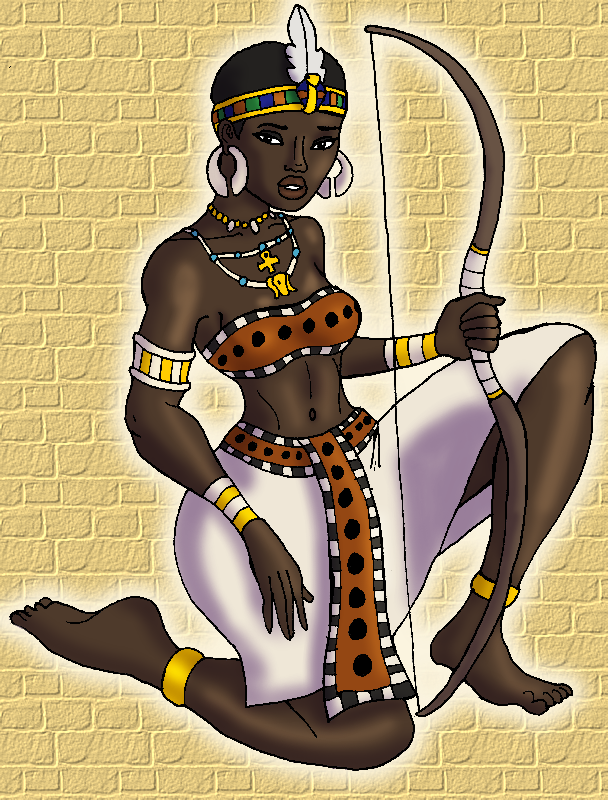
Andromeda's Pin-Up
This pin-up is supposed to depict a warrior princess from ancient Kush or Nubia, a kingdom in northern Sudan that historically rivaled Egypt. The Greeks called the Kushite people Aethiopians ("burnt faces") and praised their piety, beauty, and martial skills in literature. In Greek mythology the demigod Perseus married a Nubian princess named Andromeda after saving her from a sea monster, and together they would found the city-state of Mycenae.
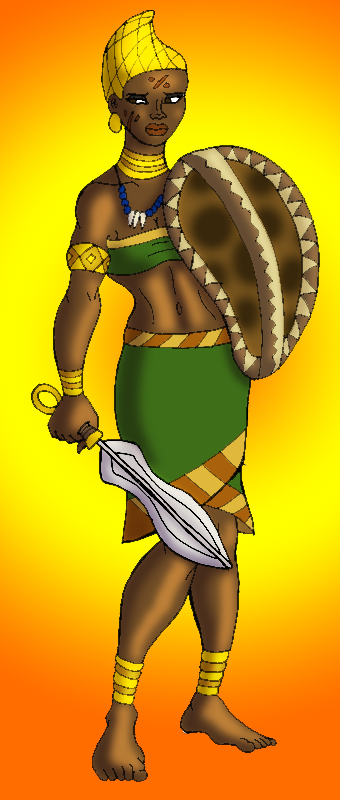
myrina_of_the_libyan_amazons_by_brandonspilcher-d75149z.png

Queen Myrina of the Libyan Amazons
Although the Amazons most people know from Greek mythology were said to live near the Black Sea northeast of Greece, the Greek historian Diodorus of Sicily did describe a second race of warrior women living "in the western parts of Libya" (i.e. Africa west of the Nile). They had a fearsome matriarch named Myrina who led them against enemies as diverse as the Atlanteans, Gorgons, Arabs, and Anatolian Cicilians. Obviously Diodorus's account of Myrina's military career sounds more fanciful than plausible, but I'm tempted to speculate that his reports of warrior women in classical West Africa might have more than a grain of truth to them. They could have been the precedents to the famous female warriors of Dahomey (in modern Benin).
 

Jabrosky

Banned
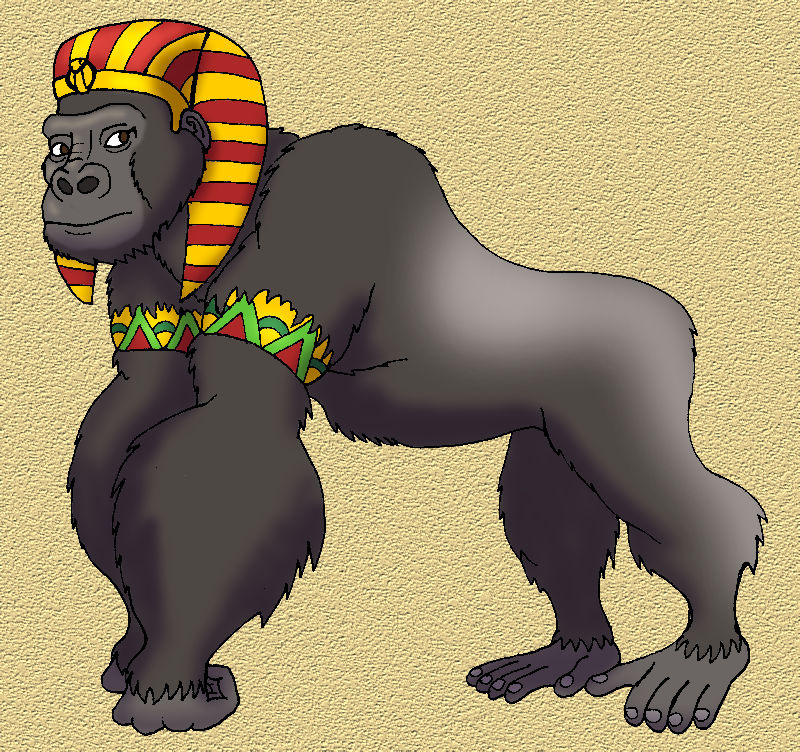
egyptian_gorilla_by_brandonspilcher-d74c4jw.png

Egyptian Gorilla
Maybe this guy hangs around the temple of Djehuti (Thoth), the god whom the Egyptians would sometimes associate with primates (though he is best known for his sacred ibis head).

I shouldn't have to add the disclaimer that gorillas were never native to Egypt since they are creatures of the rainforest. However, when I was a kid, I thought ancient Egypt was cool because of all the exotic African animals they coexisted with and even incorporated into their religion, and I probably wouldn't have thought a gorilla out of place there at all.

hikuptan_war_behemoth_by_brandonspilcher-d74bksm.png

Hikuptan Battle Behemoth
Despite its vaguely rhinoceros-like appearance, the Hikuptan behemoth (Arsinoitherium giganteum) is actually more closely related to the elephant family. It browses in small family groups within wetlands throughout the Aethiopian continent, including Hikuptah's Iteru Delta. The Hikuptan military uses these double-horned beasts as heavy shock cavalry along with elephants and hippopotamuses.

(The Hikuptans are analogous to the ancient Egyptian and Nubian peoples in one of my constructed worlds.)

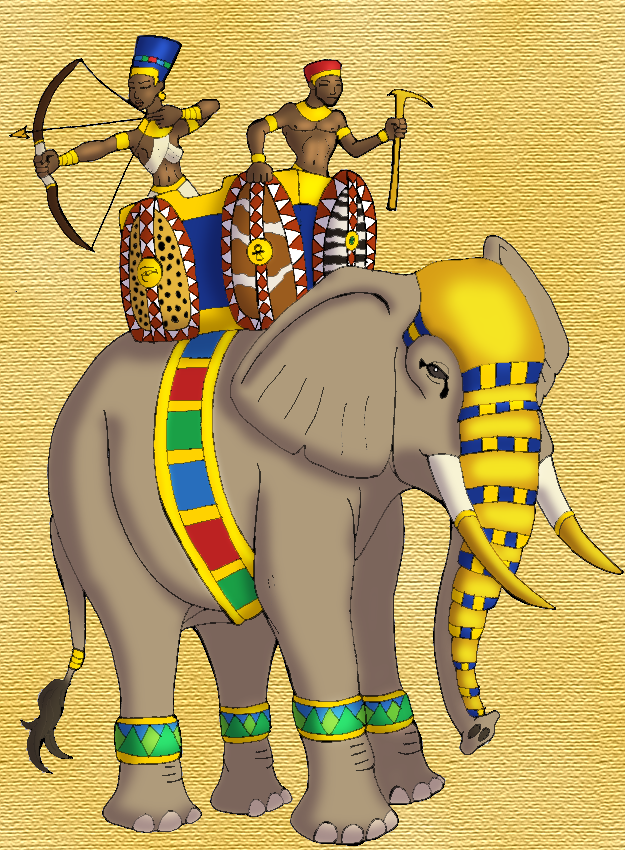
hikuptan_war_elephant_by_brandonspilcher-d74zieu.png

Hikuptan War Elephant
A war elephant commandeered by soldiers from Hikuptah, my con-world's equivalent to ancient Egypt.

Although several real-time strategy games (e.g. Age of Empires and Age of Mythology) portray the Egyptians as commanding African war elephants, in real history it was not until the Macedonian Ptolemaic dynasty that they ever employed them to a significant degree. However, it is possible that the Nubians to the south did use war elephants, as the remains of what may be elephant stables have been found near the Nubian city of Meroe.
 

Jabrosky

Banned
i_have_failed_you__father_by_brandonspilcher-d73cfc9.png

I Have Failed You, Father
"Promise me, my child, that you will care for Hikuptah as if she were you our own child and keep her peace and prosperity. Promise me you will protect her as the fiercest lioness protects her cubs. And promise me that you will appease the gods and honor our ancestors."

So said Nefrusobek's father Atumhotep the moment before he departed to rejoin the great Pharaohs of the past in the afterlife. Now that she has taken his place on the throne, Nefrusobek wants more than anything to rule her kingdom of Hikuptah with the same wisdom and benevolence as he did. This shows a hypothetical moment where she finds herself forced to abdicate (under what pressure, I will leave to your imagination) and looks to the night sky, fearing she has disappointed her father's spirit.

Incidentally, the ancient Egyptians actually did believe that their dead Pharaohs would ascend to the stars as recorded by the Pyramid Texts of Unas. Disney didn't invent the idea with The Lion King.

This isn't the first time I've drawn a Pharaoh taking off her crown, but I believe this shows more emotion than its predecessors (plus the rest were not digitally colored like this).

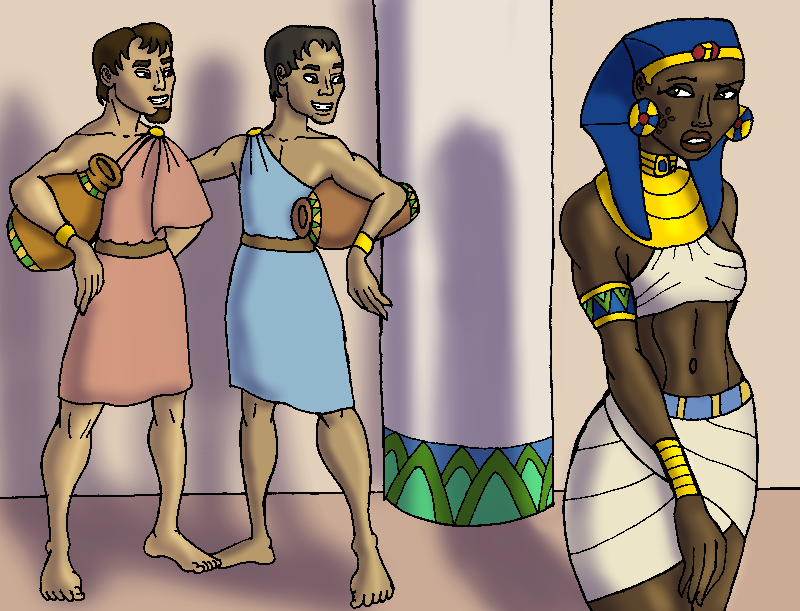
check_her_gloutos_out__by_brandonspilcher-d73noxz.png

Check Here Gloutos Out!
If there's one downside to ruling one of the ancient world's great empires as a woman, it's having your male servants ogle and catcall you like you're a pricey piece of meat. Especially if they come from a different culture not known for its progressive attitudes towards women.

(If you're curious about the art piece's title, gloutos is Greek for...well, it does lie at the root of our language's gluteus.)

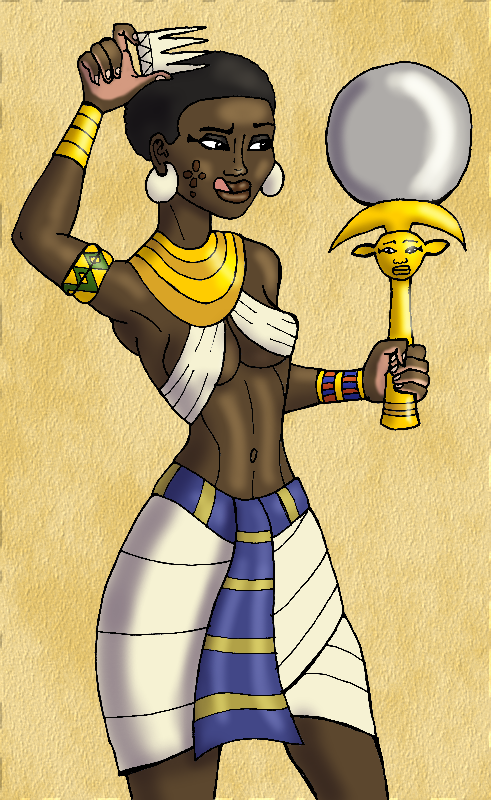
pharaoh_s_hair_maintenance_by_brandonspilcher-d73lf13.png

Pharaoh's Hair Maintenance
My OC Pharaoh Nefrusobek of Hikuptah gives her hair its daily maintenance with an ivory comb. Some of her elite compatriots like to wear wigs over their natural hair, as did the real historical Egyptians, but since Nefrusobek has to wear a crown most of the time, a wig would be superfluous in her case. Besides, natural hair still needs its grooming from time to time.
 

Jabrosky

Banned
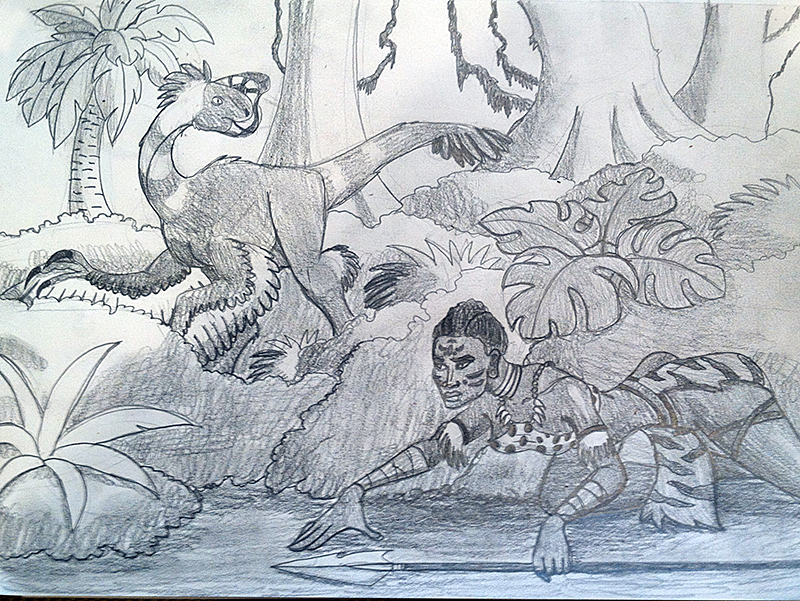
always_be_alert_by_brandonspilcher-d759793.jpg

Always Be Alert
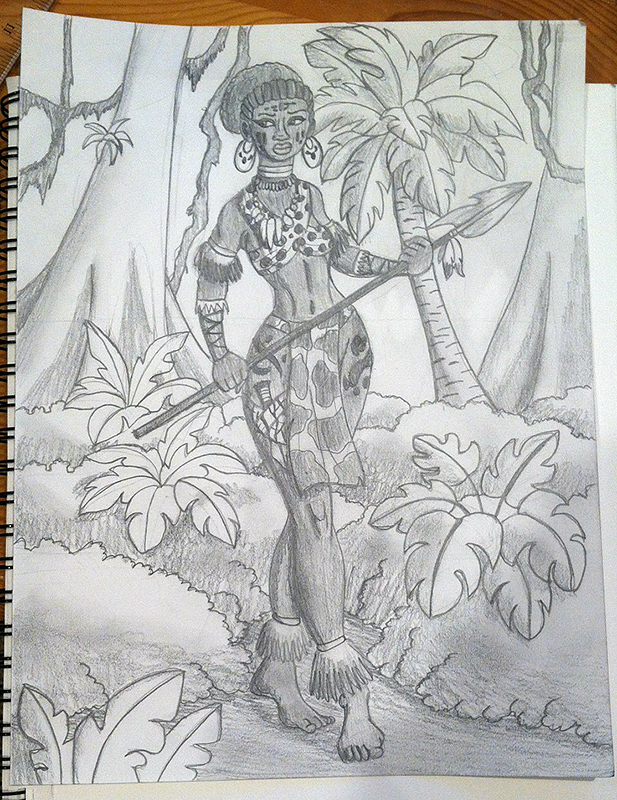
This huntress must maintain constant vigilance as she prowls in the jungle's shadowed depths, lest one of its predators ambushes her. Thankfully her ebony skin and lithe frame blend her into the darkness of the understory.

I drew this on a piece of sketchbook paper that couldn't fit into my scanner, so I had to use my iPhone to photograph it. At least it was a fun exercise in returning to traditional drawing methods.
 

Lumani

Minstrel
always_be_alert_by_brandonspilcher-d759793.jpg

Always Be Alert
This huntress must maintain constant vigilance as she prowls in the jungle's shadowed depths, lest one of its predators ambushes her. Thankfully her ebony skin and lithe frame blend her into the darkness of the understory.

I drew this on a piece of sketchbook paper that couldn't fit into my scanner, so I had to use my iPhone to photograph it. At least it was a fun exercise in returning to traditional drawing methods.

This looks great! :) I really like the detail you put into the back ground and the shading looks great!
 

Jabrosky

Banned
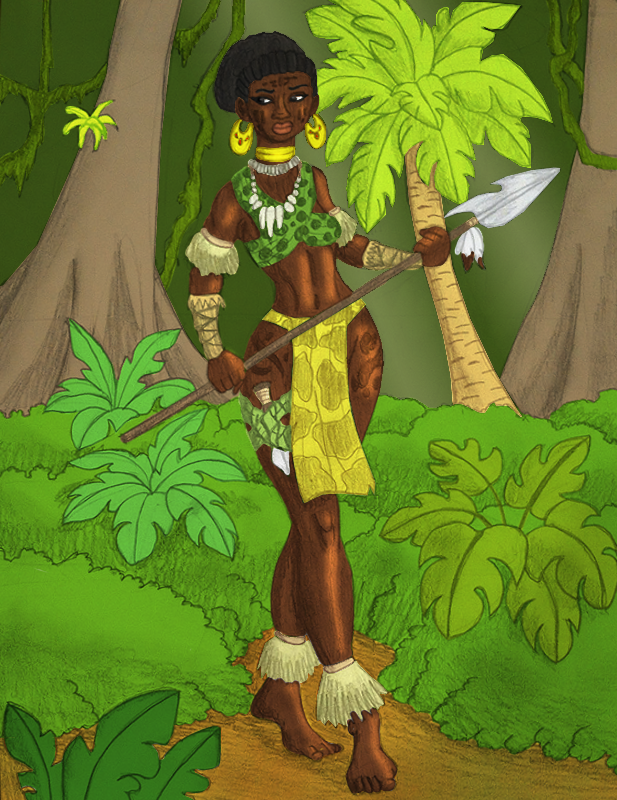
always_be_alert___colored_version_by_brandonspilcher-d75jk5q.png

Colorized version of "Always Be Aware". When colorizing this in Photoshop, I put all the colors on a layer set to the "Hard Light" blending mode. The results didn't come out the way I would prefer, but the alternative blending modes seemed even less attractive.

If you are curious, this lady's outfit is cut out from dinosaur skins, which I felt befitted a character inspired by comic-book jungle girls. The dark marks on her face and thighs are meant to be ritual scarifications.
 

Jabrosky

Banned
creeping_on_citipati_by_brandonspilcher-d75lnux.jpg

Creeping on Citipati
Sneaking through the tropical undergrowth with the stealth of a black panther, this huntress has her eyes on a wary Citipati osmolskae (a cousin of Oviraptor).
 

Jabrosky

Banned
three_character_portraits_by_brandonspilcher-d7620fw.png

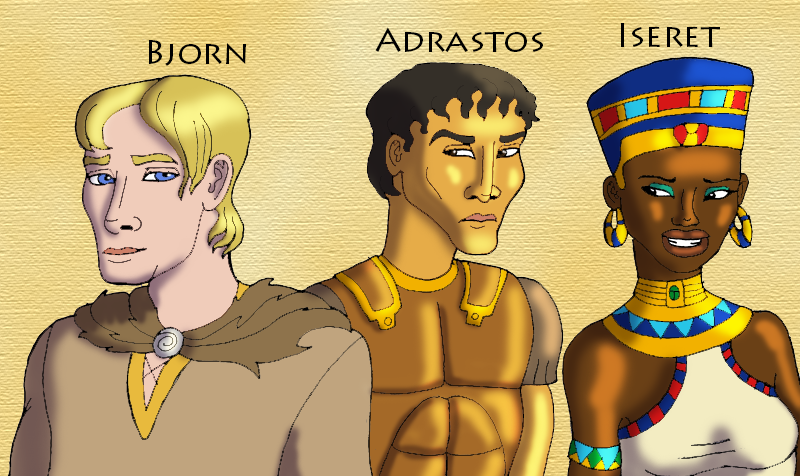
I came up with these three characters while musing on one of my older and longer-standing story concepts, in which a decimated tribe of Norsemen ally with the Egyptians against villainous Greeks. I’ve always been partial to the idea of European and African people teaming up to fight a common Mediterranean enemy.

Anyway, Bjorn is supposed to be the Norse hero of the story, Adrastos is the Greek villain, and Iseret is Bjorn’s Egyptian ally and eventual girlfriend.
 

Jabrosky

Banned
three_realms__draft_two_by_brandonspilcher-d762r5d.png

The Three Realms
Originally each of these lands was going to be the homeland of one culture ripped off from the real world (e.g. Norse, Egyptians, or Greeks), but then I decided I would enjoy more creative freedom if I scrapped the Counterpart Culture idea this time and populated these lands with more original (or at least less obviously derivative) societies.

If it isn't obvious from the color scheme, Norheim has a chilly sub-arctic climate with conifer forests and steppes, Aridia is mostly desert and Mediterranean scrubland, and Uzuri has tropical rainforests and savannas. The indigenous people of Norheim have white skin, the Aridians tend to be olive-brown like Arabs, and the Uzurians are black people.
 

Jabrosky

Banned
brunar_of_norheim_by_brandonspilcher-d763539.png

Brunar of Norheim
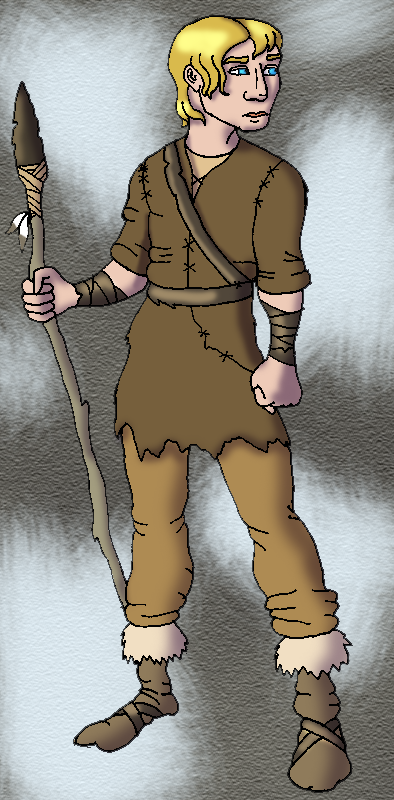
Brunar spent his early years as a hunter-gatherer in the frigid northern continent of Norheim, but a brutal twist of fate sent his decimated people fleeing across the sea to Uzuri in the far south. Brunar's parents argue over how best to lead their community; Brunar's father opts for a peaceful resettlement while his mother swears a bloody vengeance upon the Aridians whose ravages caused the Norheimers' exodus in the first place. Brunar himself leans towards his mother's side of the argument, if only because fighting in a war could give him an opportunity to prove his manly valor.

Originally Brunar was going to be a Norseman named Bjorn, but I gave him a name change and cultural makeover as I rethought his setting. His inspiration is now more Paleolithic Cro-Magnon than anything else.
 

Jabrosky

Banned
conan_and_the_dragon_by_brandonspilcher-d766s88.jpg

Conan and the Dragon
Deep in the equatorial jungles of the Black Kingdoms, Conan the Cimmerian is having an unpleasant run-in with a native dragon. Can his scimitar save him from the monster's maw, or will he have to rely on his cunning or flight?

Although Conan does actually encountered a similar dragon-like creature in the Robert E. Howard story Red Nails, this is not meant to be an illustration of that scene. Instead I got the idea for the composition from a movie still taken from the original King Kong movie (it's the one with a carnivorous Brontosaurus about to eat a sailor who's clinging to a tree).
 

Jabrosky

Banned
soljuw_specimen_by_brandonspilcher-d76l9bs.png

Soljuw Specimen
This is a type specimen for an alien species known as the Soljuw. They're slothful and obese slug-like creatures whose comfortable and futuristic standard of living depends on enslaving and exploiting other races, most especially humans. They're also genderqueer in the sense that they only have one reproductive "sex", regarding the two-sex system of humanity as abhorrent. In fact they are highly xenophobic in general, frowning upon adopting any cultural traits or practices from their human subordinates. You could say they are opposed to cultural appropriation.

I didn't create this slug-like alien with the intention of ripping off Star Wars' Jabba the Hutt. His image might have subconsciously influenced my design though.
 

Jabrosky

Banned
spinosaurus_and_the_wall_by_brandonspilcher-d77v1f6.jpg

Spinosaurus and the Wall
A Spinosaurus lumbers within sight of some ancient ruins on the African savanna. The wall is supposed to vaguely resemble the Great Enclosure in Zimbabwe, but the mask-like face on the turret came from my imagination. I've always felt ruined architecture would make a great backdrop for a dinosaur picture even if it is technically anachronistic.


alphadon_the_cretaceous_underdog_by_brandonspilcher-d77lgsu.png

Alphadon the Cretaceous Underdog
In the understory of a Cretaceous jungle, an Alphadon marshi clings to safety as a dinosaur prowls past. A contemporary of T. Rex and Triceratops, Alphadon belonged to the metatherian group of mammals that also includes marsupials like kangaroos. Little is known about this animal's appearance other than its teeth, but most artists reconstruct it as resembling an opossum which I find relatively boring. For my own depiction I chose more exotic influences like the tree kangaroo of New Guinea, the ring-tailed lemur of Madagascar, and various species of spotted cats around the world.
 

Jabrosky

Banned
Couple of characters from my short story The Gold Tusk (on display in MS's Showcase):
khalid_and_the_gold_tusk_by_brandonspilcher-d78bg29.png

Khalid ibn Najjar
Khalid is a down-on-his-luck merchant who lives with his starving family in the Masryeen city of Qahirah. In a fit of desperation he rides out into the desert to some ancient Hikuptan ruins in search of treasure, but his biggest finding there is a truth that challenges his preconceptions of history and the natural order of things. In addition he discovers a life-size elephant idol with gold tusks.

I think my drawing of Khalid made him look like a turbaned Arab version of Jesus. Some people may not like that he's stealing treasure from an ancient civilization, but I intended him to be a sympathetic if prejudiced character who cares about his family's well-being more than anything else.

mehtire_the_hikuptan_priestess_by_brandonspilcher-d78dajm.png

Mehtire the Hikuptan Priestess
Back in the heyday of the Hikuptan civilization, Mehtire served as a higher-ranking priestess for the elephant god Yebu. She doesn't actually appear until towards the story's end, but she does use her authority to save the protagonist Khalid from execution at the hands of temple guards. Although beautiful as I like my heroines, Mehtire isn't meant to be an object of romance in the story (Khalid meets her as a centuries-old ghost anyway).
 

Jabrosky

Banned
azeneith_the_hikuptan_spy_by_brandonspilcher-d78jt0c.png

Azeneith the Hikuptan Spy
This started out as a meaningless doodle (actually inspired by a photo I saw on Facebook), but as it progressed I decided to give this lady a little bit of back-story.

Azeneith (yes, I drew her name from the Biblical story of Joseph) works as a spy for Hikuptah, a fantasy civilization based off ancient Egypt and Nubia. She knows some poisons and martial arts, but her womanly wiles and cunning are her best assets. She's great as seducing her enemies to get what she and her benefactors want.
 

Jabrosky

Banned
lady_triceratops_by_brandonspilcher-d78ywty.png

Lady Triceratops
Most artistic representations of Triceratops horridus, my own included, give it curving brow horns and neck-frills fringed with little pointy knobs. Many recovered Triceratops skulls do show these characteristics, but the specimen displayed at the American Museum of Natural History is remarkable for their absence. It has straight brow horns and a heart-shaped frill with a smooth edge. I don't know if other Triceratops skulls in the paleontological record have these traits, but it made me wonder whether the AMNH specimen could represent a female of the species. Hence this portrait of a female Triceratops, complete with an earthy color scheme.

I'm not really a fan of drably colored dinosaurs, but certain shades of earthy tones can still make for exotic patterns that fit them very well in my opinion.

fishing_for_snakes_by_brandonspilcher-d791d3j.jpg

Fishing for Snakes
Deep in the prehistoric jungle, a black huntress armed with a seme dagger wrestles with a swamp-viper. It's not the biggest snake I can imagine for this setting, but then something on the scale of Titanoboa might be overkill for one lady.

That is supposed to be a Pteranodon soaring in the background over the woman's head.

lady_with_a_big_cat_by_brandonspilcher-d791xe7.jpg

Lady with a Big Cat
In the interest of adding some diversity to the warrior babes in my artwork, here's a Native American chick with her pet Smilodon. If the saber-tooth doesn't get you first, its mistress will with either her tomahawk or wooden war-club.

Although the war-club's angular design is based on actual Native American weaponry, the woman's outfit isn't meant to channel a particular Native group from real history. You could say she's from some pre-Columbian tribe that got absorbed and lost to history.
 

Jabrosky

Banned
damsel_to_the_rescue_by_brandonspilcher-d7958vs.jpg

Damsel to the Rescue
In a valiant effort to save the man she loves from a brutal execution, an African jungle huntress takes on a Tyrannosaurus rex with her seme blade.

I got the idea for this picture after looking at some pulpy adventure art that featured white male heroes rescuing damsels in distress (also white) from sacrificial rituals in exotic lands. I thought to myself, "what if it was a native black woman rescuing the white male lead instead?" As much as the jungle adventure genre appeals to me, it's even cooler when you get to subvert the old bothersome tropes.
 

Jabrosky

Banned
kemyebu_the_royal_steed_by_brandonspilcher-d79qvp3.png

Kemyebu the Royal Elephant
Kemyebu's name means "black elephant" in the ancient Egyptian language, for he has much darker coloring than normal for his species. You could say he is a rare example of melanism in elephants. Thanks to his unusual color, the people who keep Kemyebu revere him as so sacred that only their kings and queens can ride him. In this sense his experience is analogous to that of albino elephants kept by historical Southeast Asian rulers.


even_tyrants_adopt_by_brandonspilcher-d79z80w.png

Even Tyrants Adopt
67 million years before Brangelina will walk the Earth, Tyrannosaurus rex takes an adopted Triceratops horridus youngster on a stroll along the Californian coast. Reports of lions temporarily "adopting" antelope calves in the wild sparked the concept behind this.

As for the Californian setting, while neither T. Rex nor Triceratops remains have yet been uncovered from the state, I thought it would be novel to have these dinosaurs roaming along an ocean other than the Western Interior Seaway for once. Surely there had to be dinosaurs roaming the Pacific coastline in the Late Cretaceous, wouldn't there?

ramses_and_the_widowmaker_by_brandonspilcher-d7a1y2t.jpg

Ramses and the Widowmaker
Having just reached the cusp of manhood, young Ramses II undergoes a treacherous rite of passage in the Nile floodplains to prepare him for the Egyptian throne. Suffice to say that this wild buffalo (Syncerus caffer) isn't all that eager to cooperate.

This scene derives from the beginning chapter of Christian Jacq's novel The Son of the Light, first in a series of biographic novels about Ramses II. In the original text, it's actually a North African subspecies of wild cattle (Bos primigenius africanus) he wrangles with a rope, but I decided that a buffalo would have more exotic appeal. I am not sure which animal would have been deadlier though. In this picture Ramses would probably have reached somewhere between his late teens and early twenties; any age earlier than fourteen and he would have still kept his braided sidelock of youth.

carthaginian_auxiliary_by_brandonspilcher-d79fuz0.jpg

Carthaginian Auxiliary
This is meant to represent an auxiliary war elephant from ancient Carthage. I say auxiliary because the black spear-woman on top is obviously an assimilated African subject instead of an ethnically Punic (Phoenician) citizen. Much like their Roman adversaries, Carthage lorded over a polyglot group of peoples on both sides of the Mediterranean, so non-Punic soldiers such as Africans, Celts, and Iberians would have built up much of their army. As for the shield the lady's carrying, it features a real Carthaginian religious symbol in white, but the general design is based off traditional shields used by the Zande people of Central Africa.
 
Status
Not open for further replies.
Top