• Welcome to the Fantasy Writing Forums. Register Now to join us!

Maps and Descriptive Narrative

pmmg

Myth Weaver
So...as many of us put time and energy into creating are beautiful world maps (sometimes in full color), I wonder...how much does that map win you the freedom to assume the reader can just go look at the map, and spare you the need to describe in great detail things that may be on it.

As an example, If the map clearly shows a road heading south and then cutting east for a long distance, and we are typing out the journey, we start by saying they headed south, but the read might go...um...don't they need to head east? And the author might say, go look at the freaking map...then you will get it, south and then east...

Or...if you have listed out the names of towns and villages along the trails, you might just write, they arrived at bree, and reader goes...where the heck is bree, and you might say...go look at the map.

Does the narrative of the script ever win the freedom to write things less descriptively because of a map, or must it always be written with the assumption the map does not exist. Does the author ever get to say...go look at the map, or must they better be able to say...go look at the prose...its in there.

Hope I asked that right.
 

Devor

Fiery Keeper of the Hat
Moderator
I figure you can’t assume the reader will ever actually look at the map. There’s too many who won’t, and you don’t want to interrupt the flow of your story to say “now turn to page…”

But, you also have to assume the reader won’t really understand the geography unless they do. They’ll go with some simple cardinal directions. The big road, then the river, through the woods. But a picture is worth a thousand words, as they say, and without the picture, there’s only so much you can take the time explain.

For me, though, the map did two big things. The first, it forced me to think things through. I mean my whole story. These are places I want to explore, that have purpose, that have to be seen and experienced on the ground. How will my story ever get there? When will all these other places matter? I had to really consider all that to put my map together and lock it in.

And, the second thing, the other half of that, is it’s a big tease. It’s got places on it like “Tomb of the Traitor Mother” and “MekBoar’s Hairy Teets.” I want people to go “what the heck?” and get interested in what they think those things are about.
 

ThinkerX

Myth Weaver
I remember spending a lot of time looking at the maps in the old pulp novels, as well as more recent works. A pulp novel map inspired a major part of the geography of my main world.

Several reviewers of my books liked the maps and the descriptions. Others did not.
 
I would never assume that a reader keeps looking at the map. A story needs to stand on its own without it. One thing related is that I find with ebooks it's more difficult to glance at the map. With a physical book, it's a simple matter of opening the book on the first page. With an ebook, I just never do.
 

CupofJoe

Myth Weaver
I don’t use/read eBooks so won’t comment on them and maps, but in printed books a good map [even a simple one] is very helpful. A few seconds scanning it and I get the rough geography and relationship between places. That means I don’t have to have that explained to me.
I think the pen and ink maps in the Belgariad series work well. Though if you know an author well, a map can tell you a lot about where the story might go.
 

skip.knox

toujours gai, archie
Moderator
I see maps as supplemental, like a list of characters or glossary. When writing, spatial information is for the characters first,reader second.

You mentioned Bree for example. Tolkien gives us some anchor points: the road, and Rivendell. Bree becomes a waypoint in between. We know that it is roughly eastward, but northeast of southeast? How far from Hobbiton? The characters are lost and in unknown territory, but if the reader really wants to know there's the map.
 

Mad Swede

Auror
My books don't include a map of any sort, but I do have sketch maps of the whole setting and most of the major towns and cities. I need the maps to ensure that places and travel times are believable, and to make sure that parallel events in the stories hang together. My own view of maps for readers is that if I can't convey how and why the characters travel around, or if I can't create that sense of wonder in the reader about the wider setting using words then I'm not doing my job as the author.
 

Ban

Troglodytic Trouvère
Article Team
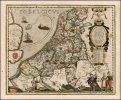
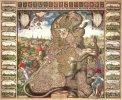
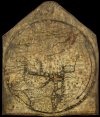
Personally I enjoy maps in fantasy, but I believe they should fit the worldbuilding. Having a mercator map filled with accurate details a their correct distances from eachother, seems to me rather unbelievable in a feudal setting. I'd much prefer seeing a map that resembles historic maps of the setting's period equivalent. There's a multitude of interesting options to explore in this field, from trade maps to world maps grounded in contemporary worldviews (mappa mundi included below). I'd rather enjoy seeing a fantasy map that bases itself on nationalist/nation-building symbolic maps such as the Leo Belgicus. Such an approach also mitigates the problem of certain readers being taken out of the narrative because they plan out the journey ahead by looking at the included map. If the map is indicative, and not reliable, there is only minor use of it for navigating purposes.

I use an "accurate" map for my own writing purposes, but I don't intend to include it in the novel, preferring instead to make a more symbolic map that fits the setting. I want readers to generate an idea of the world that is coherent with the narrative, not possess a definitive map that is supposed to illustrate the world in detail.
 

Attachments

  • 1617_Leo_Belgicus_Kaerius.jpeg
    1617_Leo_Belgicus_Kaerius.jpeg
    677.9 KB · Views: 8
  • Sitting_Leo_Belgicus_-_Visscher.jpeg
    Sitting_Leo_Belgicus_-_Visscher.jpeg
    921 KB · Views: 8
  • 1858px-Hereford-Karte.jpeg
    1858px-Hereford-Karte.jpeg
    681.3 KB · Views: 8
Last edited:

SamazonE

Troubadour
I like those things at the bottom of pages. Foot notes I think you call them. Not an appendix or a map. Maybe a foreword? There are a lot of times when I see the asterisk for reference and jump straight to it finding my place later. It is like telling myself there is a map in my head, and I can use it later. The use of a map for checking through the time you read the book could be used in conjunction with these foot notes. Say, you had a position that was kept secret, and it all started making sense later. Like a heritage spot. Maybe there was a road once to a forgotten city, and they show the map at the back of the book, and at the reading spot. Perhaps an appendix could point out various alterations.

As far as maps for a fantasy travel guide, I think that is essential. A map of the underground, Atlantis, with the show rides for the dinosaurs. They could have the catacombs, the pyramids. And a landmark is no different from a legend. They are all essential, and can be used for critical thinking. There are two choices, to use a map or not, but a map can take various forms. They can be a bother or they can be a boon. There are two other types of maps, like fully illustrated treasure maps, in children’s books, or something like Where’s Wally, I own a few. There is also the flow of time that generates fads with maps, and they can pinpoint a particular style, such as throughout history, like they do with collectables, and ancient battlegrounds with their tactics. I had a few picture books like this when I was a child. These days I do not interpret them like I used to, because I am not accustomed.

As far as maps creation goes, I like to do that myself. There are professionals who do it, but there are famous maps drawn by their authors, such as JRRT and Tolkien. The fact that it becomes an issue with royalties and illustrators who know the art form is peculiar, because I haven’t seen a person take up the mantle of such a job, but I see it everywhere. There is the possibility that you get it right, but how many times and how many choices do you get, it seems like an easy enough task.
 

Incanus

Auror
For myself, I would never stint on description/depiction in a story narrative with the idea of knowing some of the details could be found on included maps. The two things should back each other up, so as to convey a sense of verisimilitude.

I like Ban's idea above, where local maps and info is clouded by misperceptions or for political or social reasons. I'm not sure if I should include something like that in my WIP. One more thing to sleep on----
 

Penpilot

Staff
Article Team
If I make a map, it's probably more for me than the reader. I never assume they have access to or have the willingness to look at stuff outside of the main text. IMHO, if the reader has to look at or refer to something outside the text for something to make sense, then I've done something wrong.

This kind of reminds me of when I point out flaws in a terrible movie, and someone says, it'd make sense if you read the comic, the book, or some prequel material they put out, before hand. I should not have to do homework in order to consume a story that's supposed to be able to stand on its own.
 
I've recently read The Blade Itself, by Abercrombie, and that doesn't have a map. The writing is clear enough that it doesn't specifically need one. However, the story does refer to things that are further away (the story mainly happens in a single city). At some point I did look up a map online, just to make it easier for me to wrap my head around what was really happening. It sometimes just helps me to have a basic understanding of the shape of the world.
 

pmmg

Myth Weaver
I am all for making the maps and putting them in the front of the book. They are something I just want to look at.

Though...maps are also somewhat limiting... if one was to go figuring out distances and time of travel, they might notice my characters move a bit faster than they should. I think, off camera, the must hop on motorcycles, and ditch them before they come back on screen.

Heck, the opening to book 2 begins with impossible travel, The characters are aware of it. The question never really gets answered. All it means to them is, they are too far behind to catch up.
 
Top