• Welcome to the Fantasy Writing Forums. Register Now to join us!

How do you feel about the 'classic' villain monologue about their plans?

That one scene from the Incredibles movie always pops into my head -- "You sly dog! You've got me monologuing!"
The fact that it isn't just a silly joke for the audience, but also a canon problem for the super villains is hilarious.
Lore wise, they imply that the villains are actually aware of the nonsense, but they can't help themselves. It's not treated as a 'joke' in universe, but an actual thing.
 

xena

Sage
Yes, it works great (at least sometimes) on the stage where a character is explaining his inner thoughts not to another character but to the audience. We can use the interior monologue for that but stories these days rarely do an omniscient peek inside the villain's head.
That's true. I don't think I can remember the last time I read a book where they did
 

xena

Sage
Done right the laura croft example can work.
But if it's just 'randomly' thrown in, yeah, it's blatantly obvious the information isn't intended for the character in question (In this case Laura)
That seems to happen quite a bit throughout the Toomb Raider series, though the most egregious ones are the reboot series. Where she just literally happens to arrive as the enemy big bad is explaining plans. (And somehow gets away with it by hiding behind some crates or shit, I mean plot armor gonna plot armor but still, yikes.) Often, she hears just enough of the guy's plan to go 'ok they're crazy' lol
Agreed! Done right, it can work really well. But most times it's clearly not meant for the characters, rather the audience
 
Agreed! Done right, it can work really well. But most times it's clearly not meant for the characters, rather the audience
The few things that bug me is the scene tends to go one of two ways.
Protagonist gets 'caught' so they can escape later (Because plot armor)
Protagonist gets away with it in the dumbest way possible (Being well within ear shot of bad guys but hiding behind dumb crate or something)
Some protagonists do both! Which, honestly is the only one that makes sense to me.
In real life if someone snoopin on a Gang leader plotting shit, they're not going to ignore someone skulking around the room lol
 

rareruin

Dreamer
In some cases, it certainly has a place, superhero shows and whatnot.
But some movies/stories it just doesn't make sense.
My favorite instances are in some Laura Croft games where the villain is talking about their evil plan and Laura just 'happens' to be within earshot.
It makes sense lore wise, because of how Laura Croft runs into her silly adventures.
But as an audience member/game player, I wheeze. It's clear to me that this is happening to inform the player/the audience and not for any real reason otherwise.

I've seen plenty of times when it's done well, and I have seen it done poorly too.
Monologues are interesting but i do feel it destroys the narrative process as well. Perhaps there is a better way around it. Good monologues i feel should provide that character's development.
A few examples to replace or support the villain's case:
A Diary or big revealing clue.
The witness, bring in a character that knows the whole story.
Eaves dropping can be a great way to do it.
Create a situation where they know each other but surrounded by innocent people for subtle monologue where only the person it's directed at can decipher his true meaning.
 
Monologues are interesting but i do feel it destroys the narrative process as well. Perhaps there is a better way around it. Good monologues i feel should provide that character's development.
A few examples to replace or support the villain's case:
A Diary or big revealing clue.
The witness, bring in a character that knows the whole story.
Eaves dropping can be a great way to do it.
Create a situation where they know each other but surrounded by innocent people for subtle monologue where only the person it's directed at can decipher his true meaning.
From what I've seen in movies (And especially games)

Bad guy...generally shouldn't have a reason to explain his/her whole plan. (again, unless they're a super villain)
Granted most of the time they're high on their own stuff when they DO do these monologues. Or their minions are dimwits, which is a valid but paper thin excuse.

But a lot of the time the info is for the audience / player.

What I would LOVE to see (Outside of Incredibles) is a legitimate reason for these scenes to happen.
There are some shows where they make sense (Detective series) but others, not so much.

'Ah , protagonist, you have reached my quarters, allow me to honor you with my glorious plan, because I know you can't stop me muahaaha' don't get me started on the number of RPG where the villain does this, wipes the party, and just...allows them to live lol I mean I don't typically want the bad guy to win or nothing but come on.

One of the few series to take a Jab at this is The Kingsmen. The Jokes and Gaffs aren't always family friendly, but a lot of them do mock particular scenes that happen in spy films. The only one people didn't like was the (constant) reminder that the protagonist isn't James Bond.
 

xena

Sage
The few things that bug me is the scene tends to go one of two ways.
Protagonist gets 'caught' so they can escape later (Because plot armor)
Protagonist gets away with it in the dumbest way possible (Being well within ear shot of bad guys but hiding behind dumb crate or something)
Some protagonists do both! Which, honestly is the only one that makes sense to me.
In real life if someone snoopin on a Gang leader plotting shit, they're not going to ignore someone skulking around the room lol
in real life it's typically easy to note, like hello we can easily tell you're crouched behind the trash can buddy
 

Le Petité

New Member
I think it can also be used as comedic relief in some cases like kim possible or phineas and ferb but logically it makes no sense lol. or it can be reader inclusive where the reader gets to learn the grand plan but the hero doesn't know.
 
I think it can also be used as comedic relief in some cases like kim possible or phineas and ferb but logically it makes no sense lol. or it can be reader inclusive where the reader gets to learn the grand plan but the hero doesn't know.
I like this approach tbh, main bad guy discussing the plan with their 'head' minions. Normal thing that probably also happens in real life.
Protagonist happening to be there to hear said plan (in our case would be a regular old cop or spy without plot armor) and hiding behind random crates and the bad guys are as unobservant as heck while talking. I'm torn on if I like it or not, I like it when it's done for comedy (Again, super villains) but when one is expected to take the plot seriously, at least give me a more serious reason as to why the protagonist gets away with it. Like Frodo's ring.

Plenty of good films have this approach (Like The Great Mouse Detective) and it works great, plus they don't gotta be subtle with it either.

I think the other bit that bugs me in these scenes is the villain is usually like 'hey minion keep this on the down low' proceeds to explain plan.

In regards to doing it for comedy, it 100% works, that's the 'joke' especially if both the villain and protagonist are incompetent.
 

A. E. Lowan

Forum Mom
Leadership
tumblr_inline_nekx3ooJd71r0e9n5.gif
 

Malik

Auror
I know it's a movie and not a book, but The Incredibles handled this absolutely beautifully.

Sitting in the car listening to police scanners, Lucius is recounting a time when a Big Bad had him on a platter but wouldn't stop monologuing. Later, Mr. Incredible nearly snuffs Syndrome by getting him monologuing, and if you roll back, you can see exactly how he psyched him into it. At the end,
Syndrome is monologuing when the Incredibles defeat him the first time in the city, and he's monologuing again when Mr. Incredible defeats him for good on the jet.

I don't do it, because it's been done better than I ever could.

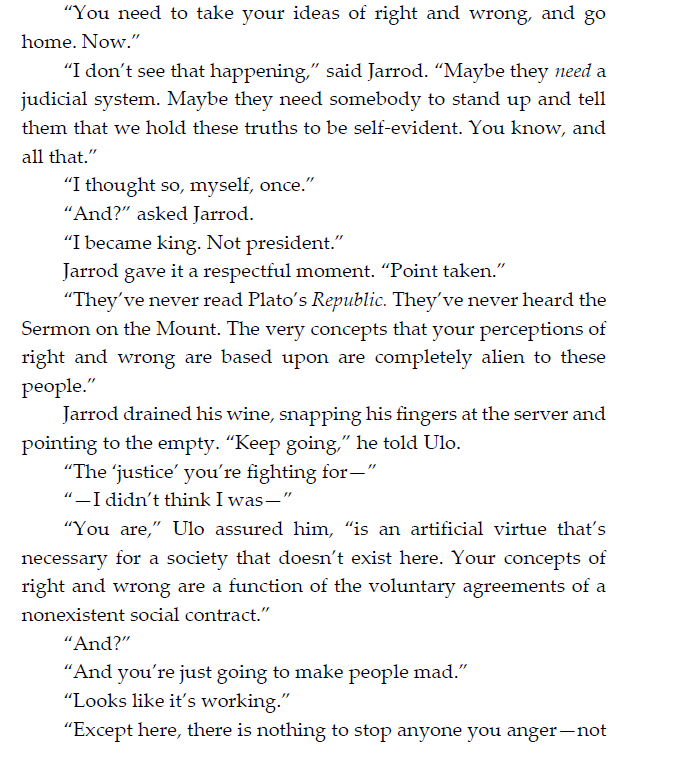
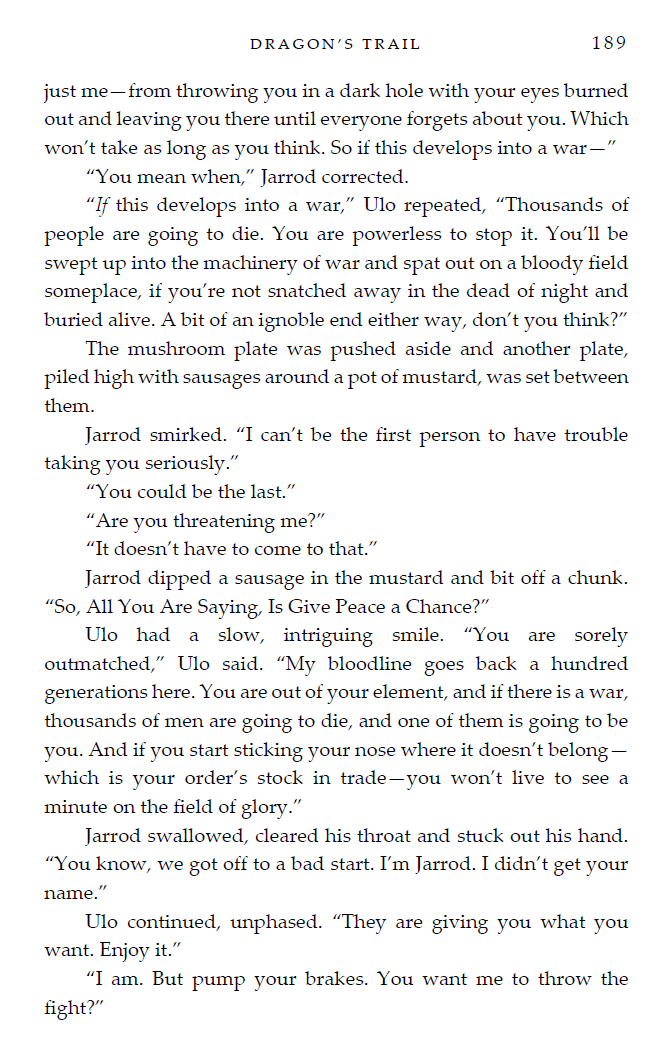
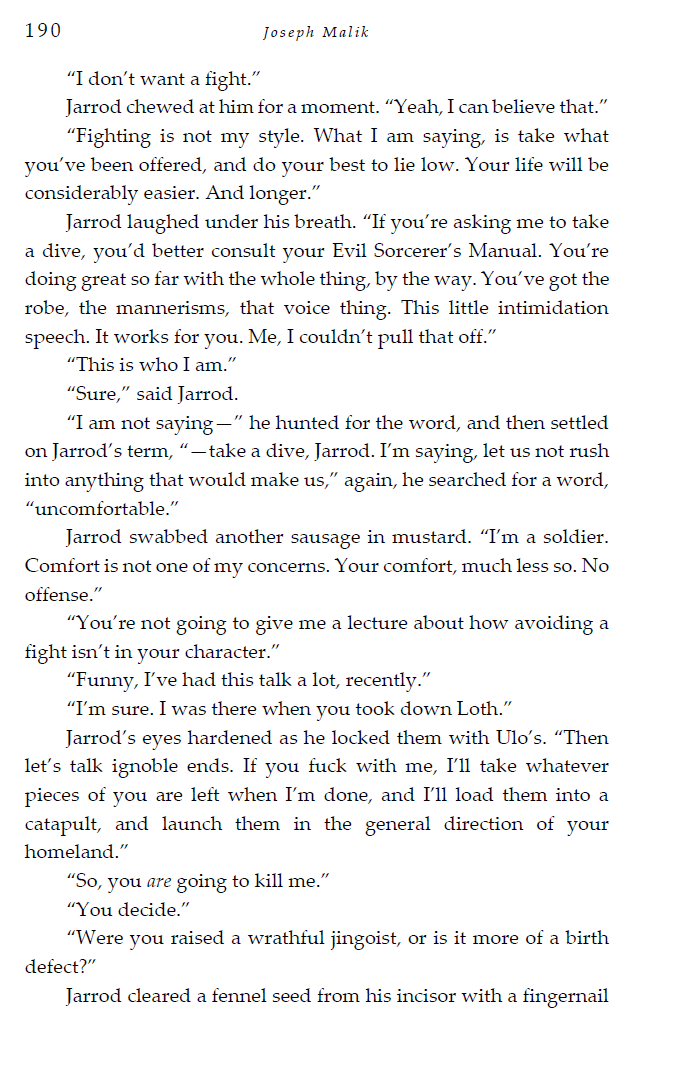
I do have a moment in each book where the Big Bad and the hero come face to face and have what we called in the Army a "no-shitter." Not so much a monologue as just a "Look, dumbass. Here's what's gonna happen." / "Okay, and here's what I'm gonna do if you do that, so please don't."

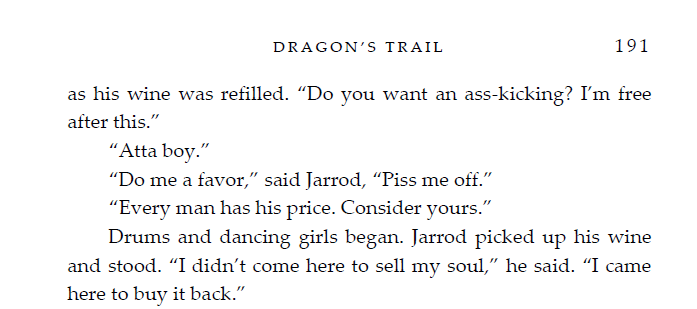
This is their initial meeting in DRAGON'S TRAIL. This delves into meta-ethical moral relativism, but stick with me because the concept plays a huge part in the series.

Ulo is literally a Chosen One; a former up-and-coming Vegas magician who wakes up in another world and learns he's the son of a powerful sorcerer. He uses his magic and his Earth education to win back his father's kingdom, coming of age in a world of magic and wonder. (AKA "Epic Fantasy Plot Number Two.")

Twelve years on, he's become such a dick about it that a neighboring kingdom sends a mission to Earth to find someone who can kill him. The man they recruit is the MC, Jarrod: a violent, drunken, womanizing stuntman scraping by on third-rate fantasy films. Once an Olympic saber hopeful, but banned from competition for killing another fencer in a duel, he initially thought this was a reality TV show. He's now learned that it's real; it's lethal; and Ulo is also from Earth. They meet. They talk.


DT-188.png


DT-189.png


DT-190.png

DT-191.png
 
I personally think the villain monologue has its place. It just needs to be done well (as with everything), and that's a hard thing to do. And when done well, most readers wouldn't really recognize it as a villain monologue. Unless you're going the cartoonish villain direction of course, then fully embrace it.

As a side note, smart people really like talking about the smart solutions they came up with and about their favorite subject matter. If you've ever asked a science student about their favorite subject, then you'll have seen that in action. So it's not as weird an idea as you'd first think.
 
I personally think the villain monologue has its place. It just needs to be done well (as with everything), and that's a hard thing to do. And when done well, most readers wouldn't really recognize it as a villain monologue. Unless you're going the cartoonish villain direction of course, then fully embrace it.

As a side note, smart people really like talking about the smart solutions they came up with and about their favorite subject matter. If you've ever asked a science student about their favorite subject, then you'll have seen that in action. So it's not as weird an idea as you'd first think.
Yep, and ask any 'special' person (Not saying this in a bad way, since I'm also on the spectrum) about their special interest, they'll often know more than most scholars on their subject. Most of the time they'll be more factually correct about it too. A good example of this was this one kid (well, college kid) who was on the spectrum. He gave lectures on trains, every time he gave a lecture the crowd loved him cause his sense of humor was both great and accurate. I wish I had saved that video because now I can't find it, it's great lol

I think the only time I would go for the cartoon villain approach is if either A: I'm writing a cartoon villain (Like doctor Eggman from Sonic) or B: I'm parodying it, in which case I have a particular villain I want to do that with. She's insanely strong, very uh, yeah, and very cartoonishly crazy.
People put up with her tangents because, A: she's clinically insane and B: if you dare to question her chop chop chop. lol
 
Top