

Good midnight folks (or whichever time it may be). Two years ago I posted a little list of different forms of immortality I came up with, which can be found here. After another idle worldbuilding session I have returned with a sequel of sorts. How fitting that the sequel consists of dualism. In short, I was pondering what different types of dualism might be feasible for various pairs of deities. "Divine duality" in this context refers to pairs of gods in fiction who are bound to each other in some tangible or metaphysical manner. What I managed to brainstorm is depicted in the image (mind the jagged edges  ). I explain my thought process behind each type and encourage readers to conceive of further additions. Feel free to use these ideas if you can find a place for them.

Combative Duality: The divine pair has separate forms, which are bonded behaviourally. They converge and diverge in a combative fashion, wherein the two sides meet to compete, but can never destroy the other. Example: A god of summer and a god of winter who are fated to wage war upon eachother cyclically, but wherein neither ever wins (one simply crossing to the other hemisphere).
Attractive Duality: The divine pair has separate forms, but these forms are bonded behaviourally. The patterns of one are synchronized with the other in some symbiotic manner. Example: A god of love and a god of beauty, always imbuing eachother's creations with aspects of their own.
Nested Duality: The divine pair functions as one form, with one of the component deities constituting the full appearance of the shared form. Beneath the surface of the one deity lies the other deity however, and beneath that layer rests the first one once more, and so on and so forth ad infinitum; Endlessly interchanging layers of gods. Example: A god of light, who when slain is replaced by the underlying god of darkness, who in turn makes way for the god of light once more when himself slain.
Constituent Duality: The divine pair functions as one form, with one deity being the dominant party. Example: A god who has absorbed another god. The absorbed god has been reduced to the dominant god's conscience, thus influencing the behaviour of the primary actor in the pair.
Hierarchical Duality: The divine pair has separate forms, but in their bond only one is dependent on the other. Example: In a divine bureaucracy exists a god of falcons and a god of falconeers. The domain of the latter is subject to the former, and without the god of falcons the god of falconeers withers.
Singular Duality: The divine pair functions as one form and is behaviourally aligned. They are two minds speaking with one voice. Example: The god of light is matched in every word, thought and motion by the god of shadow, who is inherently cast from him as a separate yet mirrored deity.
Pseudo-Duality: The divine pair has separate forms and is not bonded in a metaphysical sense, yet their behaviours are still intertwined. Example: Two gods of strategy meet eachother in the wars of humans, steering the minds of their chosen. They thus interact with the other god in a constant but not systemic or inherent manner.
Usurpative Duality: The divine pair has separate forms which cyclically usurp eachother's place, with one always being more powerful than the other. Example: A god of royalty and a god of peasantry, who exchange places through a ritualised coup every era.
Generational Duality: The divine pair has separate forms, with one of the two existing at any point. The existing god creates their counterpart when/before they cease to exist, who in turn does the same in a recurring cycle. Example: A god of day who dies in the evening. From his body rises the god of night, who himself dies at dawn, and from whose body emerges the god of day once more.
Mantled Duality: The divine pair functions as one form, with one deity having encapsulated the other. It differs from nestled duality, by lacking recurring layers of the divines. Example: Dormant within the chief god of a pantheon lies the former leader he slew and consumed to obtain the highest title.
). I explain my thought process behind each type and encourage readers to conceive of further additions. Feel free to use these ideas if you can find a place for them.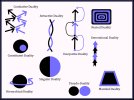
Combative Duality: The divine pair has separate forms, which are bonded behaviourally. They converge and diverge in a combative fashion, wherein the two sides meet to compete, but can never destroy the other. Example: A god of summer and a god of winter who are fated to wage war upon eachother cyclically, but wherein neither ever wins (one simply crossing to the other hemisphere).
Attractive Duality: The divine pair has separate forms, but these forms are bonded behaviourally. The patterns of one are synchronized with the other in some symbiotic manner. Example: A god of love and a god of beauty, always imbuing eachother's creations with aspects of their own.
Nested Duality: The divine pair functions as one form, with one of the component deities constituting the full appearance of the shared form. Beneath the surface of the one deity lies the other deity however, and beneath that layer rests the first one once more, and so on and so forth ad infinitum; Endlessly interchanging layers of gods. Example: A god of light, who when slain is replaced by the underlying god of darkness, who in turn makes way for the god of light once more when himself slain.
Constituent Duality: The divine pair functions as one form, with one deity being the dominant party. Example: A god who has absorbed another god. The absorbed god has been reduced to the dominant god's conscience, thus influencing the behaviour of the primary actor in the pair.
Hierarchical Duality: The divine pair has separate forms, but in their bond only one is dependent on the other. Example: In a divine bureaucracy exists a god of falcons and a god of falconeers. The domain of the latter is subject to the former, and without the god of falcons the god of falconeers withers.
Singular Duality: The divine pair functions as one form and is behaviourally aligned. They are two minds speaking with one voice. Example: The god of light is matched in every word, thought and motion by the god of shadow, who is inherently cast from him as a separate yet mirrored deity.
Pseudo-Duality: The divine pair has separate forms and is not bonded in a metaphysical sense, yet their behaviours are still intertwined. Example: Two gods of strategy meet eachother in the wars of humans, steering the minds of their chosen. They thus interact with the other god in a constant but not systemic or inherent manner.
Usurpative Duality: The divine pair has separate forms which cyclically usurp eachother's place, with one always being more powerful than the other. Example: A god of royalty and a god of peasantry, who exchange places through a ritualised coup every era.
Generational Duality: The divine pair has separate forms, with one of the two existing at any point. The existing god creates their counterpart when/before they cease to exist, who in turn does the same in a recurring cycle. Example: A god of day who dies in the evening. From his body rises the god of night, who himself dies at dawn, and from whose body emerges the god of day once more.
Mantled Duality: The divine pair functions as one form, with one deity having encapsulated the other. It differs from nestled duality, by lacking recurring layers of the divines. Example: Dormant within the chief god of a pantheon lies the former leader he slew and consumed to obtain the highest title.
Last edited:
 Myth Weaver


 Sage
Sage


