• Welcome to the Fantasy Writing Forums. Register Now to join us!

Why not call it a Zebra?

Steerpike

Felis amatus
Moderator
As a world-builder my own rabbit/smeerp issues come when I have to address animals publicly known by their Greco-Latin genus names, such as most prehistoric lifeforms. If your setting's human culture is based on pre-colonial West Africa, dinosaur names like Guanlong or Lambeosaurus are going to sound out of place (the former name is Chinese while the latter was named after a white Canadian guy).

I wouldn't worry too much about the rabbit/smeerp issue in those cases. Those aren't commonly known or recognized names to begin with, so if you call them something else that you made up I think the readers will be just fine with it.
 

Devor

Fiery Keeper of the Hat
Moderator
Still, I think first impressions matter more. I'd recommend using the z-word instead of the h, and use things like legends and clear world-building to make it clear that you do know real-world zebras' limits, and these beasts are better. You might also make them a breed of "true zebras" or some other variation on the common animal (the Firekeeper books have "royal wolves" and what they call "cousins") to remind us that the proper term isn't simply "zebra"-- but most of the time that's what people say.

I'm definitely one of those people who would see "Zebra" and think, "this person doesn't know what he's talking about" - and it would bug me unless I saw something to show me he knows that a Zebra's back isn't really right for riding like a horse. But zebra gives readers the visual, so I would want to see something like "flat-backed zebra" to straighten it out.

Legends are nice, multiple varieties are nice, but sometimes those things can just give it more time and attention than it's worth. I can't answer as to whether it's worth it or not in this case.
 

Scribble

Archmage
You've got to have some faith in readers. You've got a pretty dense reader if they can't figure out from zebras being ridden, trained, and bred in the story that this is possible.

A little dialogue could clear it up.

Apart from the herd was a separate corral. One lone zebra colt trotted along the fence, trying to follow the herd's movements.
"Why is that one separate?" said Kita.
"He's a wilder. Makes trouble," replied Zuranas.
"How so?"
"Well, once in a while one is born like his wild ancestors. Can't be broken. He won't leave the herd, but he makes the rest jumpy and prone to trouble."
"What do you do with him?"
Zuranas scattered flies with a linen scarf, his face pinched with irritation. "Look, why don't you run along now."
"Tell me."
"We do the only thing we can do. What do you think? Now stop pestering me."
 
Last edited:

Daichungak

Minstrel
The best suggestion I have heard so far is describing them as “banded horses” or something similar. IMO As a reader this conveys the domestication of a horse with the looks of a zebra in the easiest way. All you really need to do is tell the reader what it does and how it looks doing it, they will create the rest if it matters to them.
 
Hi,

As I recall in WWII the Germans tried to use zebras as riding / freight animals across the African battlefields. The main problem they had wasn't that the animals were too difficult to domesticate it was that they were small compared to horses and didn't have the greatest stamina.

However more on topic, I'd stay away from using the term zebra as its a very loaded word coming with connotations of Africa. Unless your work is set there it's just going to distract readers as they constantly wonder why a zebra is wandering through the pages of your book. I'd tend to go with something like striped horses.

Cheers, Greg.
 

Caged Maiden

Staff
Article Team
I wrote a post about zebras a while ago, wherein I mentioned that zebras are difficult to domesticate. Zebras are wild asses, not horses. Fundamentally, they're different animals than the domesticated horse, much closer to their other ass cousins. The nobility tried during the sixteenth century to get the beautiful striped animals to haul coaches and abandoned it because they couldn't get the same results as with horses. So... my suggestion would be to figure out what characteristics you think are important for your animals to have and go from there.

In Russia, in I think the 70's, when the fur trade was huge, the fox furriers came up with a clever idea. Why not breed the friendly animals and in doing so, get foxes that were easy to raise.

Problem was, that with descendents of wolves, funny things happen when only the friendly animals breed. Within 12 generations (or something), the foxes no longer looked like foxes. They looked like domesticated dogs. Some had spotted coats, others floppy ears. They resembled our common pet dog breeds. SO they abandoned their selective breeding program and instead just bred moody foxes with beautiful coats.

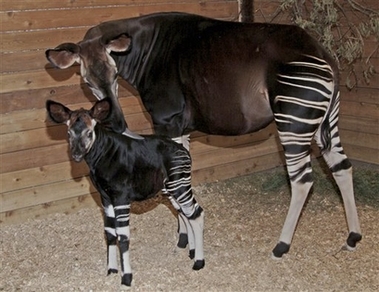
Domestication takes on several complications, not the least of which being that when you breed an animal for friendliness, intelligence, etc. You sometimes activate recessive genes and come up with a whole new animal, just within a few decades. So, if you're looking for a way to make stripey horses, why not go with that? I personally think the Okapi is a beautiful animal and there's definitely a possibility of creating animal breeds with distinctive color markings. I guess in closing, I'd say that you should do what you feel is best, but researching domestication of wild animals will lead you to better results. This animal is a completely different thing, not an antelope, not a giraffe, not a horse, not a deer...

okapi.jpg


1164691395.jpg
Pretty cool huh? Especially for something most closely related to a giraffe...Maybe you could make a separate species entirely.
 

Guru Coyote

Archmage
This thread has really been worth starting :)

Yes, Caged Maiden, I am very aware of the Russian 'pet fox' and what it tells us about domestication of wild species... They have been one of the inspirations for my use of 'striped horses' or what ever I end up calling them. Esp. the fact that, when you domesticate a species, you do NOT get an animal that looks like its wild cousins, and just behaves itself. You get... something else, maybe a pet.

One of the key elements for the "Silvertree bloodline" of my world is that they did manage to create a domesticated riding animal that does have the looks of its wild cousins, while all other breeds are very much similar to what we would call horses, no stripes etc.
the idea behind the Silvertree bloodline is along the lines of certain dog breeds that have 'wolf looks' - say the husky etc. (and before someone jumps on me for saying husky looks like wolf.. I know, I know, he does NOT, but people tend to think he does, which is the whole point.)
 

Caged Maiden

Staff
Article Team
I don't see a problem with that. The thing I always like to tell people is, "Breaking the rules is fine, as long as you know what rules you're breaking and why." :) As long as you have an understanding of exactly what sort of breeding went into your domesticated animal, I think it will be fine. It sounds like your grasp on domestication is pretty good. Some people don't understand the intricacies of selective breeding, so I always try to point out the fox example, to let people know how quickly you end up with a new species when you selectively breed for friendliness or whatever. I'd suggest coming up with a new name altogether, then. I don't like the thought of calling it a zebra, because technically, a zebra is a wild ass, not a horse, and if you bred them from horses, then they should have their own name. if, however, they're descended from wild zebras and are domesticated, striped asses... then maybe zebra is a perfect word, but you may want to alter it slightly to differentiate the wild ones from tame. Maybe Zebri, zebrin, zebrel... i don't know. Something similar?

How long has this been a separate species from whatever parent species it branched from?
 

Guru Coyote

Archmage
How long... that is a good question.

My current - purely world-building - thought is that the real 'horses' got extinct due to some genetic-related issues (a specific disease etc.) and thus the various zebra species (and ass species) were the only viable option left. Those got domesticated into something that closely resembles our horses in form and function. The Silvertree bloodline is insofar special, as it achieves the coat of wild zebras while still being a rideable and rather friendly breed.
Going from my original notes about 'horses' in my world, I'd say that there are only ancient historical texts that hint at a different species of horses (the ones we know). With that thought, I'd say that the zebra-horses of my world have been domesticated and bred for maybe 600 years at least, as that is how far historical records reach back.... roughly.

There are 'wild cousins' which the breeders of the Silvertree tradition/family were trying to emulate, but just as our 'zebras' consist of several species that can not easily interbreed... I'd say that the domesticated ones are quite separate from them, at least as far apart as our horse and zebra (which can interbreed but will have sterile offspring = mules etc.)
 

Caged Maiden

Staff
Article Team
with that much time involved in the separate breeding of the animals, I don't see any issue with having a separate bloodline that has been very specifically intended for your purposes. I'd compare it more to cattle breeding though than the fox example, just because equines and bovines are very different than canines in how their temperamental-type genes and their physical appearance genes react. But, look at appaloosas or dun ponies or steppe ponies or Orlov trotters. Horses, like dogs, come in all shapes and sizes and are varied in appearance, musculature, attitude and temperament, and work load capabilities.

You know, I was really amazed to find out that big horses like modern thoroughbreds (as opposed to quarter horses or some smaller breeds), have a load capacity of about 250 pounds. Wow, really? Maybe take that into consideration too. That while Belgian draft horses are monstrous in size, they're gentle giants, bred for so many years to work closely with humans and pull plows, whereas some thoroughbreds (that I've met), are psychotic nut jobs because all they were bred for was speed. Al thoroughbreds are descended from the Godolphin Arabian, just like all German Shepherds are descended from three dogs. SO you could have started with a very small gene pool for your special breed and it isn't impossible for the mutations to have happened quickly in that case. Perhaps there's even expeditions to capture wild cousins from time to time to expand the gene pool. Maybe there's special people who are tasked with finding and acquiring the next generation's breeding stock from the wild. There's an infinite amount of possibilities here.
 

Guru Coyote

Archmage
My little story-mind is buzzing with all the possibilities :)
I'll just have to watch out for Madame Silvertree now, or she might hijack the book and make it a history of steed breeding!

As to how to Name the Beast... I do have a solution for that one now, I think, but I will keep that secret for a bit longer, it would be a spoiler for my Iron Pen Round X entry...
What I will say is this: my world has its own calendar system along with a non-standard numerical system. Every day of the calendar has a connection to two animals, which are sorted and thus have numbers. The names for those numbers could well be the common name for the animal in question.
 
Top